Most travelers walk into a Japanese convenience store looking for a quick onigiri or a cold can of coffee. They find what they came for, pay at the register, and leave. But spend enough time in Japan — not just in the tourist corridors, but in the quieter residential neighborhoods, the small provincial cities, the towns where nobody else from your country seems to have wandered — and you start to notice that the konbini, as it’s known locally, is one of the most revealing windows into how Japanese society actually functions.
This isn’t about the food, though the food is genuinely worth your attention. It’s about what the existence and operation of these stores tells you about Japanese daily life, community infrastructure, and the particular way this country has organized itself around convenience, trust, and quiet efficiency.
Why the Konbini Is Not What You Think It Is
The word “convenience store” undersells the institution entirely. In most countries, a convenience store is a fallback — the place you go at midnight because nothing else is open, or when you’ve run out of milk and don’t want to drive to a proper supermarket. In Japan, the konbini is infrastructure.
You can pay your utility bills there. You can receive packages, send packages, and pick up concert tickets. You can print documents, send faxes, and — in many locations — access government administrative services. During natural disasters, konbini chains have historically operated as emergency distribution points for food and water before official relief networks could mobilize. The Japanese government has, in some capacity, formally recognized them as part of the country’s disaster preparedness system.
This tells you something important: Japan has built its everyday civic life partly around private commercial infrastructure in a way that most Western countries haven’t. The post office, the bank, the copy shop, the pharmacy, and the deli have all been partially absorbed into this single, brightly lit, 24-hour institution. That consolidation didn’t happen by accident. It reflects a cultural preference for systems that work quietly, reliably, and without requiring you to explain yourself to anyone.
Reading the Layout Like a Local
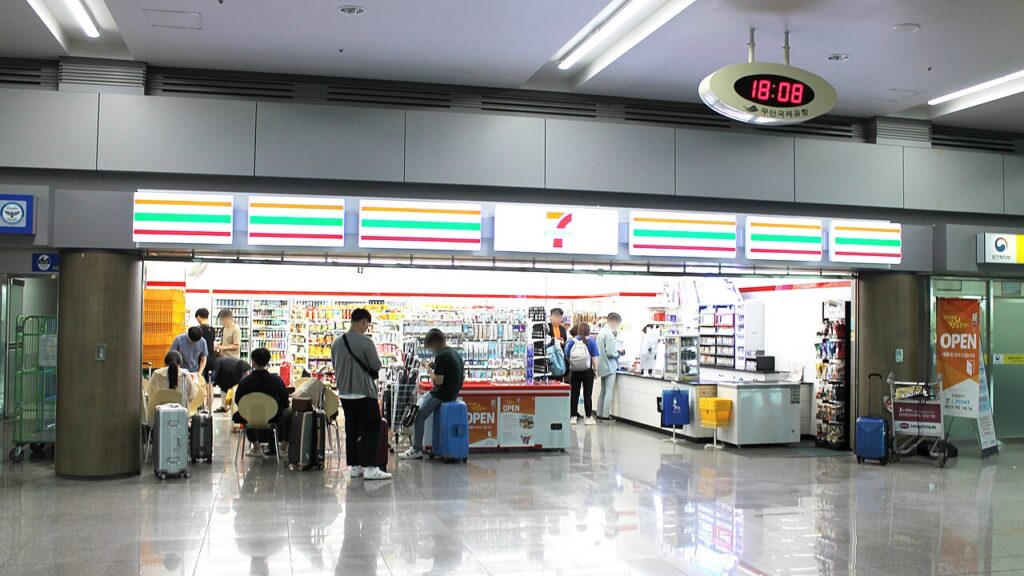
Walk into any 7-Eleven, FamilyMart, or Lawson in Japan and the layout follows a logic worth understanding. The hot food counter — steamed buns, fried chicken, corn dogs kept warm under orange heat lamps — sits near the entrance, partly because the smell draws people in, but also because these items are perishable and the staff needs to monitor them. The onigiri and sandwiches occupy a dedicated refrigerated section, organized by filling type with a precision that reflects the Japanese tendency to categorize things carefully rather than pile them together.
Near the register you’ll almost always find the ATM, the multi-function copy machine, and the ticket terminal. This placement is intentional: these services generate foot traffic, and foot traffic near the register increases impulse purchases. But the arrangement also means that someone who comes in purely to pay a bill or print a document will almost certainly walk past the hot food on the way out. The store’s design is thoughtful in the way that a lot of Japanese commercial design is thoughtful — quietly manipulative in the service of genuine usefulness.
The Seasonal Shelf and What It Reveals
One of the most underappreciated aspects of the konbini experience is the seasonal rotation of products. Japanese convenience stores change a significant portion of their inventory four to six times per year, aligned with both the calendar seasons and with cultural events: cherry blossom season brings sakura-flavored everything, summer brings cold noodles and sports drinks in flavors that disappear by September, autumn brings chestnut and sweet potato products, and winter brings oden — a simmered stew of fish cakes, tofu, and root vegetables kept in a large heated pot near the register.
This seasonal sensitivity is not a marketing gimmick. It reflects a genuine cultural value in Japan around shun — the idea that food, and by extension experience, has a proper season, and that eating or doing something in its correct season is more meaningful than having access to it year-round. The konbini, for all its corporate efficiency, has absorbed this value and built it into its supply chain. The fact that you cannot buy canned oden broth in July isn’t a limitation. It’s a statement about how time is supposed to work.
The Staff, the Silence, and the Social Contract
If you’ve spent any time in a Japanese convenience store, you’ve heard the greeting: irasshaimase, called out the moment you cross the threshold. It’s a formal welcome, and staff are trained to say it regardless of whether they’re facing you or stocking shelves with their back turned. First-time visitors sometimes find this startling. After a while, it becomes part of the ambient texture of the place.
What’s worth noticing is what happens at the register. The transaction is performed with a kind of ceremony — your items are handled carefully, your change is counted back to you with both hands, your bag is presented rather than shoved across the counter. Nobody is being theatrical about this. It’s simply the standard. The standard exists because Japanese service culture holds that the person behind the counter is performing a role that deserves to be performed well, regardless of the stakes involved.
This connects to something broader about how public behavior works in Japan. There’s a social contract operating in these spaces — an unspoken agreement that everyone will move efficiently, speak quietly, and not impose on anyone else’s experience. The konbini enforces this contract architecturally: the aisles are narrow enough to discourage lingering, the lighting is bright enough to make loitering uncomfortable, and the transaction process is streamlined enough that there’s rarely a reason to stand at the counter longer than necessary. It’s a designed environment, and the design works.
What the Late-Night Konbini Shows You About Loneliness and Community
Visit a convenience store in a Japanese city at two in the morning and you’ll encounter a particular cross-section of humanity: a salaryman eating a bento standing up at the counter shelf along the window, a university student buying cigarettes and a canned highball, an elderly man in slippers who appears to have come down from an apartment upstairs. Nobody is talking to each other. Nobody seems to expect to.
Japan has one of the highest rates of social isolation among developed nations, a phenomenon that has been extensively documented and debated domestically. The konbini, open all night, staffed and lit and stocked, functions partly as a social anchor for people who have few other reasons to leave their apartments. It’s not a community in any conventional sense. But it provides the minimum infrastructure of human presence — another person behind a counter, a warm meal, a reason to get dressed and go somewhere — that for some people makes a significant difference.
This is not something the chains advertise. But it’s something the Japanese government has quietly acknowledged in conversations about the social role of local retail. Understanding it changes how you experience the late-night konbini, transforming it from a curiosity into something more complicated and more human.
Practical Notes for Travelers
- The ATMs at 7-Eleven Japan accept most international cards and are the most reliable option for foreign travelers needing cash. FamilyMart and Lawson ATMs work for many cards but have more variable compatibility.
- Hot items near the register — fried chicken, steamed buns — are made fresh throughout the day. Early morning and late evening are the best times to find freshly restocked items rather than items that have been sitting under the heat lamp for hours.
- The copy machines (marked as kopī on signage) can print PDFs from a USB drive or via a smartphone app. This is genuinely useful if you need to print a reservation confirmation or a museum ticket.
- If you’re traveling in rural Japan — along the Mogami River towns of Yamagata or through smaller prefectures — the konbini is often the only place open after 7pm and the most reliable source of hot food. Plan accordingly.
- Eating inside the store is generally acceptable at the small counter areas near the window. Eating while walking outside, however, is still considered slightly poor form in most parts of Japan.
The Detail Most Travelers Miss
There’s a small ritual that happens at the register that most foreign visitors never notice because it happens quickly and without explanation. When you pay, the cashier will place your change on a small tray rather than handing it directly to you. You take it from the tray. This seems like a minor thing, but it’s a deliberate design choice — it avoids hand-to-hand contact in a culture where physical touch between strangers carries a different weight than it does in many Western countries, and it ensures the transaction is clean, visible, and unambiguous for both parties.
Learning to read these small details — the tray, the seasonal shelf, the two-in-the-morning bento eater standing alone at the window — is what separates a trip to Japan from an understanding of it. The konbini isn’t just a place to buy snacks. It’s a daily-use artifact of a society, and like the neighborhood notice boards that paper the walls of residential Japan, it rewards the traveler who slows down long enough to actually look.
Some of the most clarifying moments in Japan don’t happen at temples or in tea houses. They happen under fluorescent lights, at a laminate counter, while you’re waiting for your change to appear on a small plastic tray.