You are standing at a ticket machine in Shinjuku Station. There are sixteen lines. The interface is in Japanese. The person behind you is already sighing. You have forty seconds, maximum, before you become a problem. This is not the moment to be calculating fares.
There is a better way, and it fits in your wallet. IC kādo (ICカード) — Japan’s rechargeable transit cards — are the single most useful object a visitor can carry, and most people treat them as nothing more than a train pass. That’s like buying a Swiss Army knife and only ever using the toothpick.
The card works on trains, yes. It also works on buses, taxis, ferries, convenience stores, vending machines, lockers, and a growing number of restaurants. In practical terms, it works almost everywhere cash does, and in several places where cash is an inconvenience. Once you have one loaded with ¥3,000, you can move through an entire day in Tokyo without opening your wallet once.
Which Card, and Where to Get One
The two cards visitors encounter most often are Suica (Suica、スイカ) — issued by JR East, primarily in eastern Japan — and ICOCA (ICOCA、イコカ), issued by JR West and common in Osaka, Kyoto, and Hiroshima. For most purposes they are interchangeable: both work on the majority of transit networks and retailers nationwide.
Get a Suica at any JR East station in Tokyo — Narita and Haneda airports both have machines with English interfaces. The minimum load is ¥1,000, and there’s a ¥500 deposit you get back when you return the card. If you have an iPhone or Android, Suica can also be added to Apple Wallet or Google Wallet before you leave home, which means you can land in Japan with a working transit card already on your phone.
One practical note: during peak tourist seasons, physical Suica cards have occasionally sold out at major stations. The mobile version has no such problem.
On the Train
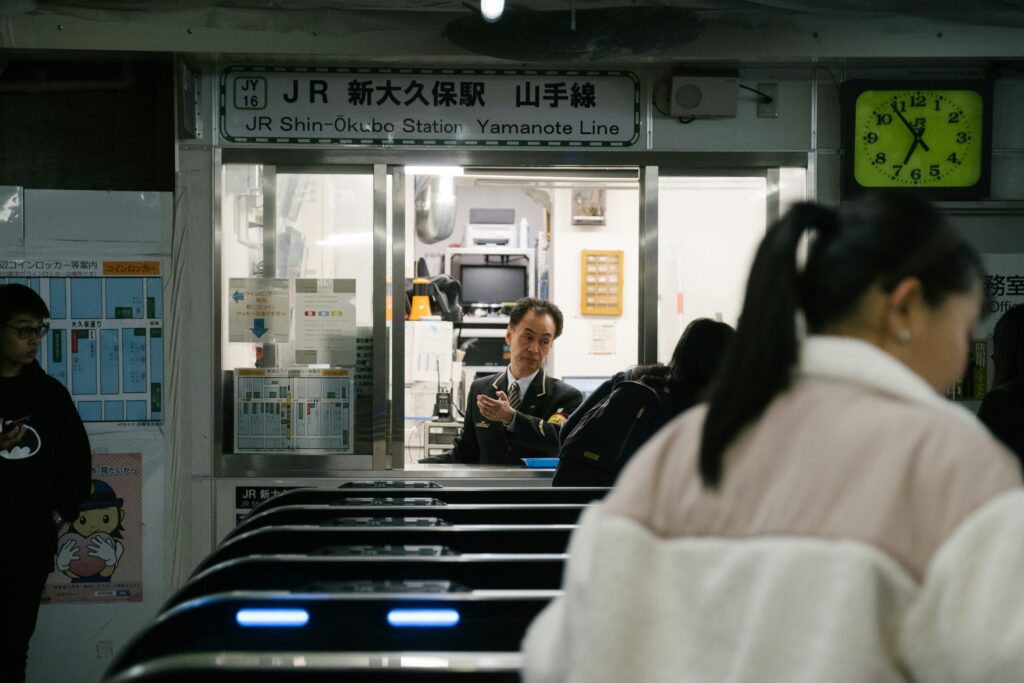
Tap in, tap out. That’s it. The fare is calculated automatically and deducted from your balance. No ticket, no calculation, no fumbling. If your balance runs low, you can top up (chāji, チャージ) at any green JR machine or at the midori no madoguchi (みどりの窓口) counter — but also, increasingly, at convenience store registers, which is where this card starts to reveal its real character.
The one thing to check: keep at least ¥150 on the card at all times. If you tap in with a balance too low to cover any possible fare, the gate will let you through — but you’ll have to settle the difference at a fare adjustment machine on the other end, which adds exactly the kind of friction the card is supposed to eliminate.
At the Convenience Store
This is where the IC card stops being a transit pass and becomes something closer to a way of life. Every kombini (コンビニ) — every Lawson, FamilyMart, and 7-Eleven in the country — accepts IC cards at the register. You pick up your onigiri and your canned coffee, you tap the card on the reader, and you’re done before the person behind you has finished unzipping their wallet.
The speed matters more than it sounds. Convenience stores in Japan move fast. The staff are efficient to a degree that feels almost algorithmic. Paying with an IC card puts you on their level. Paying with cash, particularly foreign cash requiring change, does not.
| Card | Issuer | Best for | Mobile wallet |
|---|---|---|---|
| Suica | JR East | Tokyo, eastern Japan | Apple Pay, Google Pay |
| ICOCA | JR West | Osaka, Kyoto, Hiroshima | Apple Pay, Google Pay |
| Pasmo | Tokyo Metro | Tokyo (interchangeable with Suica) | Apple Pay, Google Pay |
| Manaca | Nagoya area transit | Nagoya, central Japan | Limited |
At the Vending Machine
Japan has approximately one vending machine (jidōhanbaiki, 自動販売機) for every twenty-three people, which means they are essentially furniture. Hot coffee, cold beer, hot soup, umbrellas, fresh eggs — the range is wide enough that you can, in theory, sustain yourself for several days without entering a single shop.
Most machines now have an IC card reader panel on the side, usually marked with the Suica penguin or a generic denshi maney (電子マネー) sticker. Tap, select, collect. A canned coffee from a vending machine costs between ¥120 and ¥160 and requires approximately four seconds to purchase. This is a transaction so frictionless it feels almost too easy, and then you do it seventeen more times over the course of a week because why wouldn’t you.
“The vending machine is Japan’s truest democracy: the same canned coffee, the same four-second transaction, available to everyone at 3am outside a shuttered supermarket in a neighborhood whose name you never caught.”
The Thing No Guidebook Says
Every guide will tell you to get a Suica. Fewer will tell you that the IC card is also quietly one of the best tools for navigating the social texture of Japan.
Cash transactions in Japan are precise and ceremonious — money is presented in trays, change is counted aloud, receipts are offered with two hands. It’s a ritual, and a meaningful one. But it takes time, and in a busy kombini or a packed train station, it creates a small but real moment of friction between you and the flow of the city. The IC card removes that friction entirely. You stop being the tourist calculating coins at the register and start moving at the same speed as everyone else.
That speed is not about efficiency for its own sake. It’s about being present in the city rather than managing the logistics of being in it. Load ¥5,000, tap your way through the day, and top up when you remember. The city will feel considerably less like something you’re navigating and considerably more like somewhere you live.
Suica o わすれずに。