Nobody told you about the bit between Nakameguro and Yutenji. It’s not on any list. There’s no Famous Landmark, no photogenic staircase that’s been on someone’s Pinterest board since 2019. There’s a dry cleaner, a tiny yakitori place with four seats, a vending machine that’s been selling the same canned coffee since before you were born, and an old man walking a dog that looks exactly like him. You will walk through it in eight minutes and forget about it immediately, which is a shame, because that eight minutes is more Tokyo than anything you’ll see at Senso-ji.
The real city doesn’t live in its destinations. It lives in the aida (間) — the in-between spaces, the gaps, the connective tissue that most visitors treat as something to be crossed rather than experienced.
Tokyo’s train network is, depending on your perspective, either the greatest feat of urban logistics in human history or an overwhelming maze of colored lines and kanji. Both are true. But what the transit maps don’t show — what they can’t show — is everything that happens in the five to fifteen minute walk between one station and the next.
The Logic of the Walk
Tokyo was not planned the way Western cities were planned. It grew organically around its rail lines, each station pulling a small village’s worth of shops, restaurants, and residences into its orbit. The result is that the city is not really one place. It is two hundred small places stitched together by train lines, each with its own character, its own regulars, its own unwritten rules about how loud you’re allowed to be on a Friday night.
The tourist circuit connects the famous stations — Shinjuku, Shibuya, Asakusa, Harajuku — and skips almost everything else. This is understandable. Time is limited and the famous places are famous for a reason. But the famous places are also performing themselves for visitors. The Tokyo that actually functions — the one where people buy their vegetables and argue about baseball and get their bikes repaired — exists one or two stations in any direction from wherever you currently are.
The walk between stations is where that city becomes visible.
How to Do It
The method is simple enough to feel like cheating. Pick any two adjacent stations on a line you’re already using. Don’t take the train between them. Walk instead.
Don’t use Google Maps for navigation. Look it up before you leave so you have a rough sense of direction, then put the phone away. What Maps will do is route you efficiently, which means it will take you along the straightest, widest road and get you there in the minimum possible time. That road is the least interesting road. The interesting roads are perpendicular to it.
“The best streets in Tokyo are the ones the algorithm has no reason to recommend.”
Walk toward anything that looks residential. In Tokyo, residential means narrow: streets barely wide enough for a car, houses close enough together that you can hear someone’s television through the wall, potted plants arranged on doorsteps with the kind of care that suggests their owner has nothing more important to do, which is probably not true but is a pleasant thing to believe.
What You’re Looking For
You are not looking for anything specific. That is the point. But there are things worth paying attention to.
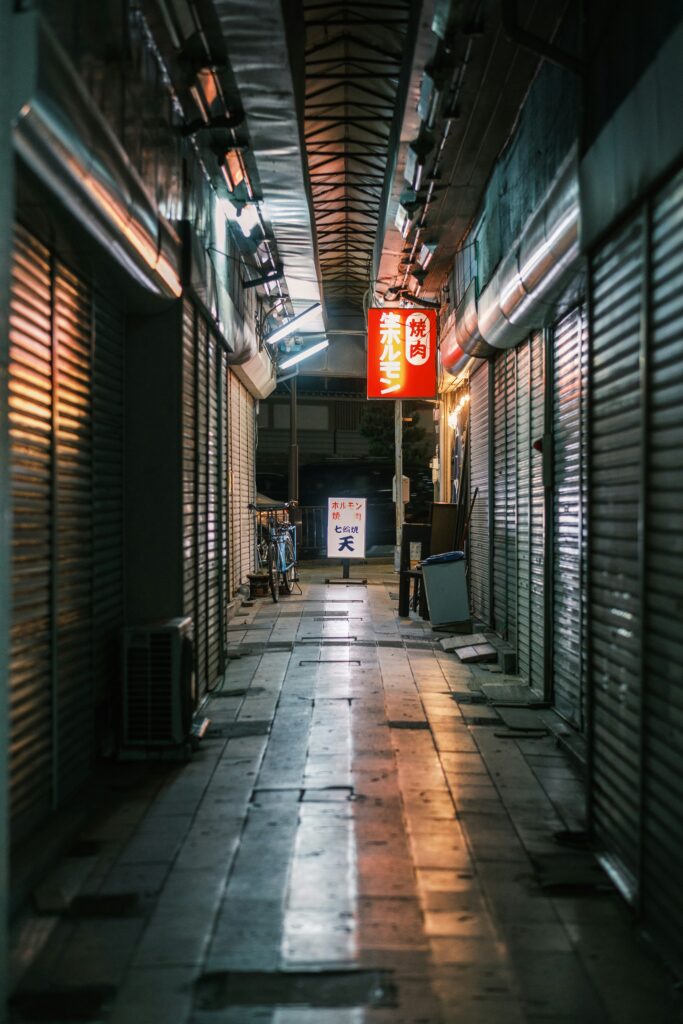
Shōtengai (商店街) are covered shopping arcades — not the expensive kind in Ginza, but the neighborhood kind, slightly faded, with a butcher and a fishmonger and a shop selling things you cannot identify and a coffee place that has been there since the 1960s. They are everywhere and almost never mentioned in travel guides because they’re not photogenic in the way that travel guides require. They are, however, the clearest window into how the city actually feeds and clothes itself.
Small shrines appear without warning. Not the grand ones with tour groups and souvenir stalls — jinja (神社) the size of a parking space, wedged between apartment buildings, maintained by nobody visible and yet always clean, always with fresh flowers or a recently lit stick of incense. They feel private in a way that makes you slow down.
Shotengai, shrines, and the spaces between them follow no tourist logic. They exist for the people who live here, which is exactly why they’re worth finding.
Reading the Stations Themselves
Part of learning to read Tokyo between the lines is learning to read the stations themselves — not as transit hubs but as social documents. Each one tells you something about the neighborhood it serves.
| Station area | Character | What to look for |
|---|---|---|
| Koenji | Old bohemian, musicians, vintage | Jazz bars, second-hand record shops |
| Sangenjaya | Young locals, slightly scruffy | Standing bars, cheap ramen, live music venues |
| Monzen-Nakacho | Working-class shitamachi | Old-school izakaya, river walks, shrine festivals |
| Shimokitazawa | Students, theatre, independent shops | Used clothing, small theatres, coffee shops |
| Nishi-Ogikubo | Antiques, quiet, older residents | Antique furniture dealers, slow cafés |
None of these neighborhoods are secrets. But the spaces between them — and between the stations that serve them — are where the city stops performing and starts being itself.
The Thing No Guidebook Says
Tokyo is a city that reveals itself incrementally, and only to people who are willing to be inefficient. The tourist infrastructure is so good — the trains so punctual, the signage so clear, the Google Maps routing so frictionless — that it is entirely possible to spend two weeks here and never once be lost, never once take a wrong turn, never once stumble into something you weren’t looking for.
That frictionlessness is a trap. The city’s best experiences don’t have addresses. They happen in the gap between where you were going and where you ended up: the restaurant you walked past three times before noticing it was a restaurant, the old woman who corrected your umbrella-folding technique on the train platform without breaking stride, the vending machine selling hot canned oden at 11pm outside a shuttered supermarket, which is either depressing or perfect depending on your mood.
Walk between the stations. Get a little lost. Consult the phone less. The city is right there.
Sanpo.