There’s a moment every first-time visitor to Japan experiences. You step off the Shinkansen at Tokyo Station, the doors slide shut behind you, and suddenly you’re standing in a corridor the size of a small airport with hundreds of people moving in every direction with complete, unhurried confidence. Nobody looks lost. Nobody is staring at their phone. They just walk.
You, meanwhile, are frozen.
Japanese train stations aren’t complicated once you understand their internal logic. But that logic isn’t written down anywhere in a way that makes sense to foreign visitors. It’s absorbed. It’s visual. It’s spatial. And once you start reading a station the way locals do — as a system of layered signals rather than a maze — you realize the whole thing is actually designed to be intuitive. You just need to learn the language it’s speaking.
The Color System That Most Visitors Overlook
Every major train line in Japan has its own color. This isn’t decoration. It’s navigation infrastructure.
The Tokyo Metro Ginza Line is orange. The Marunouchi Line is red. The Yamanote Line is green. These colors appear consistently on signs, on the line maps on platforms, on the edges of the train cars themselves, and on the colored stripe running along the platform floor near the screen doors. Once you internalize which color belongs to which line, you can navigate a transfer at Shinjuku Station — the busiest station in the world — without reading a single word.
Follow the color. It sounds simple because it is. But most visitors don’t notice the system exists until someone points it out.
How to Read a Japanese Station Sign
Japanese station signs follow a format so consistent you’ll find it across every train system in the country, from the Tokyo Metro to a single-track rural line in Shikoku.
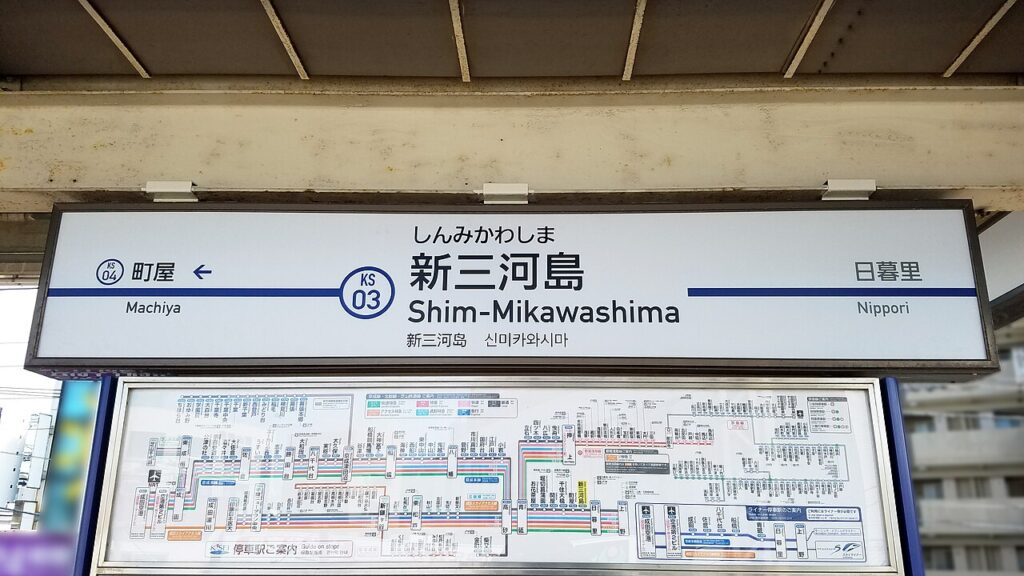
Each sign shows three things: the name of the current station in Japanese, romaji (the romanized spelling), and often the station number. Flanking the current station name are the previous station on the left and the next station on the right, slightly smaller. This means you never need to memorize a route map. You only need to know the name of your destination and whether it appears to the left or right of where you currently are.
Station numbers are particularly useful. The Ginza Line, for example, labels its stations G-01 through G-19. If you’re at G-07 and need G-12, you know you need five stops in the direction where the numbers increase. No Japanese required. No app required.
The Numbering Logic on Platforms
Look down at the platform floor when you arrive. You’ll notice numbered markers — usually circles or rectangles — spaced along the platform edge. These correspond to where each car door will stop. The signs above each marker often show a small diagram of the train, indicating which cars have priority seating, which cars are women-only during rush hours, and sometimes which car is closest to the exit at your destination station.
That last detail is worth paying attention to. At busy transfer stations like Shibuya or Osaka’s Umeda, arriving at the wrong end of the platform means a long walk through crowds to reach the exit or connecting line. Locals choose their car deliberately. With a little observation, you can do the same.
Exit Numbers Are More Useful Than Exit Names
Japanese stations — especially large urban ones — have dozens of exits. They’re labeled by number and sometimes by nearby landmark: Exit A1, Exit 3, Takashimaya Exit, South Exit. When someone gives you directions in Japan, they’ll almost always reference an exit number. When a restaurant or hotel sends you an address, the exit number is often included.
The practical habit to develop: before you board a train, check not just which station you’re getting off at, but which exit you need. This is the one moment where a quick phone check before you enter the station saves you significant confusion later. Once you’re on the platform at your destination, you want to be walking with purpose, not standing against a pillar scrolling through Google Maps while the rush-hour crowd flows around you.
What the Floor Is Telling You
Pay attention to the tactile paving — those yellow raised dots and lines running along station floors and platforms. They’re designed primarily for visually impaired passengers and form a complete navigational network throughout the station. The dotted tiles signal a stop or caution point. The lined tiles indicate direction of travel.
Beyond accessibility, these lines often run directly toward key station features: exits, ticket gates, platform staircases. Following them won’t always take you exactly where you need to go, but in an unfamiliar station they can orient you quickly toward the main flow of foot traffic.
The floor also tells you where to queue. Those painted lines or small footprint symbols in front of train doors aren’t suggestions. Queuing is one of the most deeply held social habits in Japanese public life, and the lines exist because the system works precisely because everyone follows them. Standing in the middle of a queue line when you’re not boarding that train is one of the few things that will earn you a visible reaction from otherwise patient commuters.
Understanding the Ticket Gate as a Threshold
The ticket gate — the kaisatsu — is more than a fare checkpoint. It marks a distinct boundary between the public city and the paid station environment. Inside the gates, you’re in a separate world with its own shops, restaurants, and sometimes entire underground shopping streets.
One thing that trips up visitors: you cannot freely move between different train operators’ paid areas, even within the same physical station building. JR lines and Tokyo Metro lines share station names and sometimes buildings, but their paid areas are separate. Entering the JR gates when you need the Metro means paying twice. The signage distinguishes between operators, but you need to be looking for it.
If you’re using an IC card like Suica or Pasmo — and you should be — the gate will beep and flash red if your balance is too low or if you’ve entered the wrong paid zone. Don’t panic. Step aside, find the fare adjustment machines (they’re always near the exit gates, marked clearly), and sort it out there. Station staff at the manned gate are accustomed to helping confused tourists and will do so without any visible irritation.
The Manned Gate Window
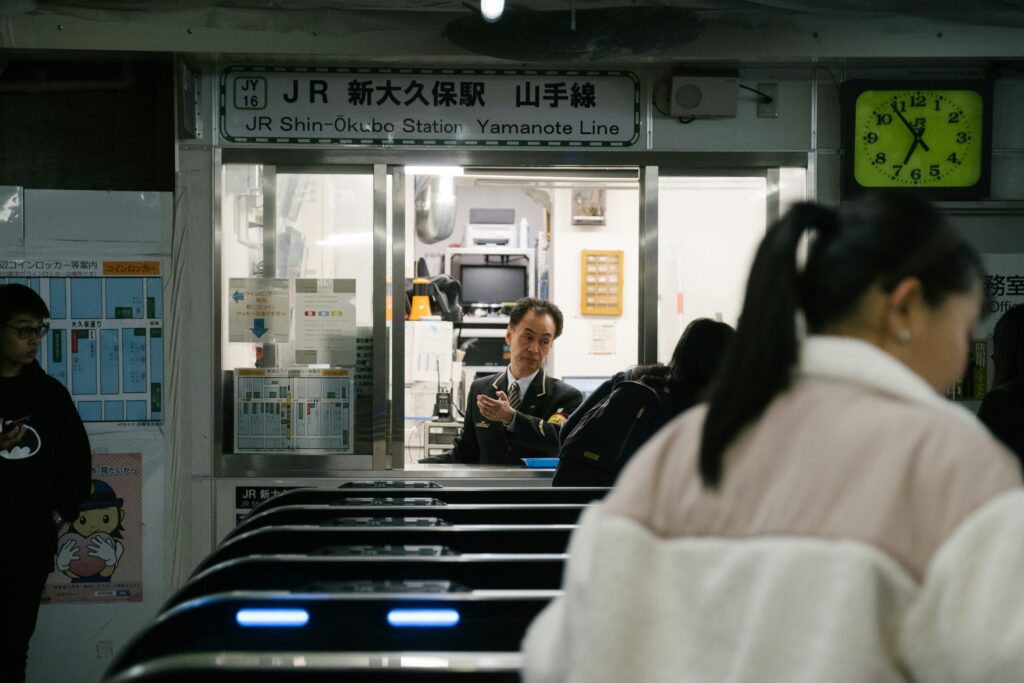
Every ticket gate area has at least one manned window staffed by a station employee. This person handles everything from lost items to fare disputes to passengers who feel unwell. If you’re genuinely stuck — wrong train, wrong zone, IC card malfunction — walk to this window. A simple piece of paper showing your destination works perfectly if the language barrier is real. Japanese station staff are trained to solve these problems quickly and without fuss.
Reading the Atmosphere, Not Just the Signs
There’s a softer navigation skill that takes a little longer to develop, but it’s surprisingly effective: reading the crowd.
At large stations, people move with intention. The density and direction of foot traffic tells you where the main exits are, where the popular platforms are, and — during rush hour — which routes to avoid if you’re not in a hurry. If you’re heading toward a major exit and you’re fighting the crowd, you’re probably going the wrong way.
Watch where people slow down. In Japanese stations, a sudden reduction in walking pace usually means a junction, a staircase, or a platform entrance is just ahead. People aren’t stopping to look around — they’re adjusting for what they know is coming. That subtle shift in pace is a signal worth noticing.
A Few Practical Habits Worth Building
- Screenshot the station map before you enter. Underground, your data connection often drops at the worst moment.
- Learn the kanji for exit (出口), entrance (入口), and transfer (乗換). These three characters will appear constantly.
- If you’re transferring between lines, follow the transfer signs from the moment you exit the train. Don’t wait until you reach the ticket gate to figure out where you’re going.
- Give yourself time. Rushing through a Japanese station as a first-time visitor almost always results in the wrong train. Five extra minutes of calm navigation is worth it.
Why This All Matters Beyond Getting from A to B
Learning to read a Japanese train station is really an exercise in a broader skill: learning to pay attention to designed environments. Japan invests enormous care in public infrastructure, not just to make it functional but to make it legible. The color systems, the floor markings, the car position guides — none of this happened by accident. It reflects a cultural priority around collective movement and consideration for others that runs through Japanese public life in general.
When you stop depending entirely on your phone and start reading the station itself, something shifts. You become a participant in the system rather than a passenger being carried through it. You start noticing the small, deliberate details that most tourists walk past entirely.
And you’ll find, somewhere around your third or fourth day, that you’re walking through a station with the same quiet confidence as everyone else — not because you’ve memorized anything, but because you’ve finally started paying attention to what was always there.