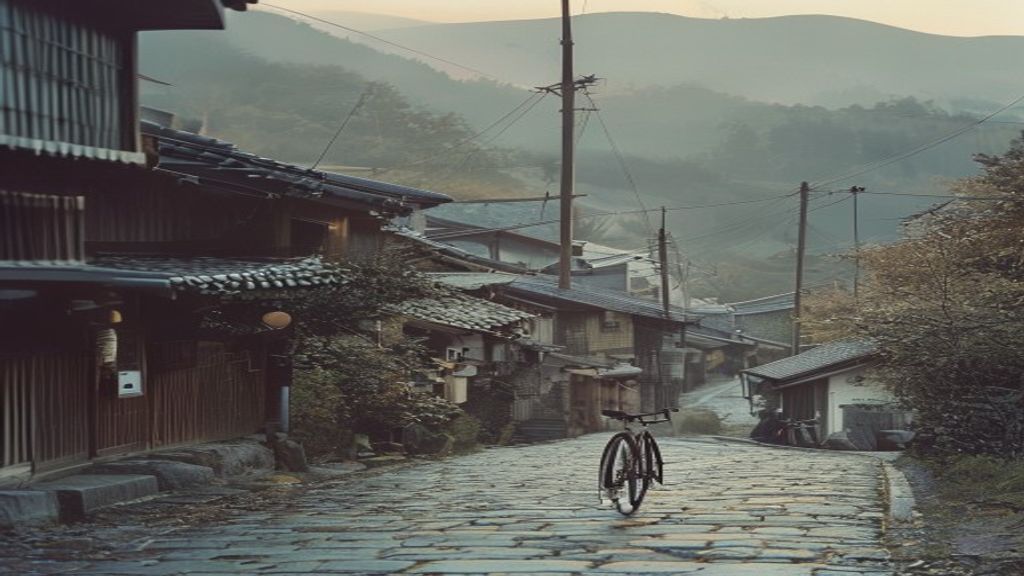

There’s a particular kind of street you find in certain Japanese cities — wide enough to suggest it once carried something important, lined with old merchant houses whose eaves nearly touch, ending abruptly at a rise in the ground where, if you look carefully, you can still see the stone foundations of a wall that no longer exists. These streets don’t appear on tourist maps. They don’t have signs explaining what they were. But if you know what you’re looking for, they tell you everything.
Japan has over a hundred surviving castle towns — called jōkamachi (城下町) — scattered across the country, many of them now ordinary regional cities where people commute to work, buy groceries, and complain about the weather. The castles, if they still stand at all, are often reconstructions. The samurai are long gone. But the bones of those feudal towns are still there, embedded in the modern street grid, hiding in the angles of intersections and the placement of rivers and hills.
Most travelers know about Kanazawa, Himeji, and Matsumoto. What’s worth exploring is what happens to a castle town when it becomes just a town — and what that transformation reveals about how Japan carries its history forward without always announcing it.
Why Castle Towns Were Built the Way They Were
To understand why these cities look the way they do today, it helps to understand why they were designed the way they were centuries ago.
During the Edo period (1603–1868), Japan was divided into roughly 260 domains, each controlled by a feudal lord called a daimyō. The castle wasn’t just a military fortress — it was the symbolic and administrative center of an entire regional economy. The town that grew around it was engineered with deliberate precision.
Samurai residences were placed closest to the castle, arranged in concentric rings of status. Merchants and craftsmen occupied the outer districts, organized by trade — hence the persistence of street names like Kajiya-chō (blacksmith district) and Gofuku-chō (textile district) in cities that haven’t seen a working blacksmith in a century. Temples and shrines were positioned at the edges of town, serving as both spiritual boundaries and defensive buffers. Rivers were redirected. Hills were incorporated into the defensive plan.
The whole structure was a map of the social order made physical.
When the Meiji Era Arrived and the Logic Changed
The Meiji Restoration of 1868 didn’t just abolish the samurai class — it systematically dismantled the spatial logic that had organized Japanese cities for two centuries. Castles were sold off, demolished, or converted into military barracks. The old class-based zoning collapsed. Railways arrived, usually cutting through the old districts without any particular respect for what had been there.
What’s remarkable is how much survived anyway.
Because the street patterns of jōkamachi were built on practical geography — rivers, hills, natural chokepoints — they couldn’t simply be erased. The new modern city had to grow around the same topography. So the streets stayed, even when everything built on them changed. The deliberate bends and dead ends that once confused potential attackers now confuse delivery drivers. The wide avenues that once allowed rapid troop movement now carry morning commuter traffic.
Reading a Former Castle Town on Foot
The Street That Turns for No Obvious Reason
In many former castle towns, you’ll notice that streets don’t follow a simple grid. They bend unexpectedly, fork at odd angles, or suddenly narrow without any modern explanation. This was deliberate. Straight streets allow an enemy to charge without obstruction. A street that turns forces any attacker to slow down and become visible before reaching the next section.
Walking through the old merchant districts of Kakegawa in Shizuoka Prefecture, or the former samurai quarters of Kitsuki in Oita — a town so well-preserved it still separates its old samurai and merchant districts with a literal valley — you feel this in your body before you understand it intellectually. The city keeps redirecting you. It’s disorienting in a way that a grid city never is.
Temples at the Edge of Everything
One of the most consistent features of former castle towns is the clustering of Buddhist temples at the town’s perimeter. This wasn’t purely religious geography. Temples were substantial structures with thick walls and loyal communities — they functioned as the last line of defense before open countryside. In an emergency, they could shelter soldiers and store supplies.
Today, those same temple districts tend to be the quietest parts of these cities. The commercial center has usually migrated toward the train station, which was almost always built at a distance from the old castle core. The temple neighborhoods are left behind — full of moss-covered graves, old wooden gates, and a particular mid-afternoon silence that feels out of place in a functioning modern city.
The Cities Most Worth Exploring for This Reason
Kitsuki, in Oita Prefecture on Kyushu, is one of the most structurally intact examples in Japan. The town was built on three plateaus divided by two valleys — samurai lived on the upper plateaus, merchants in the valleys below. That arrangement is still completely legible today. You walk down into a valley and the architecture changes. You climb back up and it changes again. The social geography of the Edo period is right there, in the elevation.
Obi, in Miyazaki Prefecture, is sometimes called the “Little Kyoto of Kyushu” — a phrase that doesn’t do it justice. It’s a small town built around the Ito clan’s domain, with samurai residences, a castle ruin, and a merchant street that still feels structurally coherent. The town is quiet to the point of feeling slightly suspended in time, not because it’s been artificially preserved, but because the economy simply never required tearing it down.
Taketa, also in Oita, offers something different — the emotional weight of a castle town that lost its castle and never quite recovered. The stone ruins of Oka Castle sit on a ridge above the town, overgrown and silent, while below, the city carries on with a slightly melancholy dignity. For anyone interested in how Japan holds its losses, Taketa is worth the detour.
This kind of layered reading — understanding what a place was by observing what it’s become — is part of what makes traveling slowly through regional Japan so rewarding. It connects to the same attentiveness described in The Abandoned Post Towns of the Nakasendo: What Happens to a Road When History Moves On, where the physical remnants of a road reveal more about a society than any museum exhibit could.
Practical Advice for Visiting Former Castle Towns
- Travel by regional train or bus. The most interesting castle towns are rarely on shinkansen lines. The journey itself — through rice fields and small stations — is part of the experience.
- Get a paper map at the tourist information office. Many smaller castle towns publish walking maps that mark the old district boundaries. These are far more useful than phone navigation for understanding the historical layout.
- Look for street name plaques. In many Japanese cities, old neighborhood names survive on small plaques even when the neighborhood itself has changed completely. A street called Samurai-machi or Teppō-chō (rifle district) is telling you exactly what it once was.
- Walk the perimeter of the old castle grounds. Even when the castle itself is gone, the moat, earthworks, or stone foundations often remain. Circumnavigating them gives you a physical sense of the scale of the original fortress.
- Visit in the morning. The temple districts and old samurai quarters are best experienced early, before the day’s activity picks up. The light is better, and the silence is more complete.
What These Places Actually Tell You About Japan
There’s a tendency, when thinking about Japanese history, to focus on the moments of rupture — the Meiji Restoration, the Second World War, the postwar economic transformation. Those ruptures were real and profound. But what former castle towns demonstrate is the extraordinary persistence of structure beneath change.
Japan rebuilt after the war. It modernized with extraordinary speed. But it did so largely on top of the existing urban skeleton. The street that bends for no obvious reason in a contemporary Japanese city is often bending for a reason that’s 400 years old. The neighborhood that feels quieter and slightly separate from the commercial center was probably always slightly separate — just for different reasons.
Understanding this doesn’t require a history degree. It requires walking slowly and paying attention to what the city is doing rather than just what it’s showing you.
There’s a phrase in Japanese — katachi ni nokoru — roughly meaning “what remains in form.” It’s used in craft and architecture to describe how intention survives in shape even after the original purpose has changed. Walking through a former castle town, you feel that principle everywhere. The samurai are gone. The domain is gone. The social order that built these streets has been gone for over 150 years. But the form remains, quietly insisting that the past is never quite as far away as it appears.