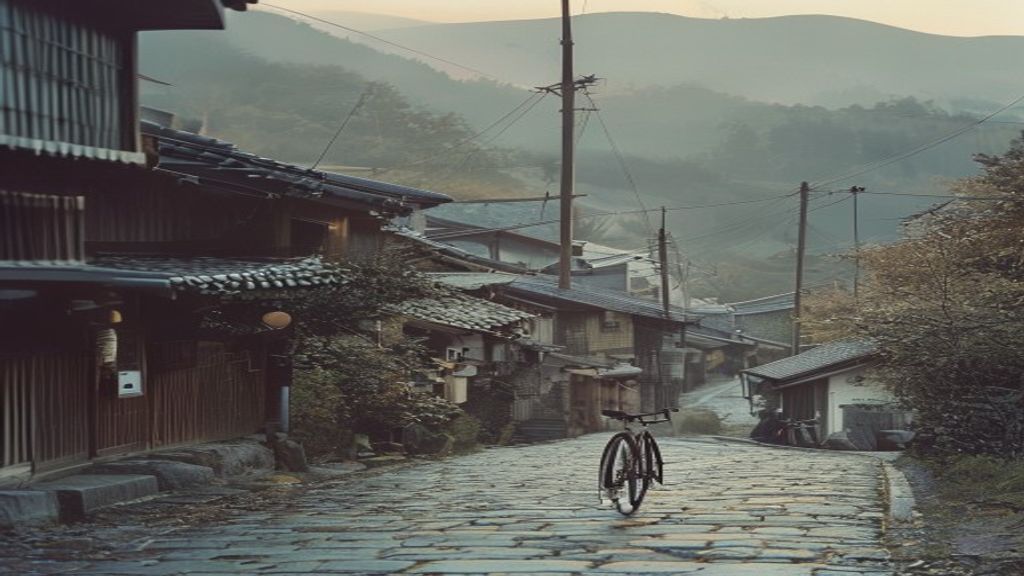
There is a particular kind of quiet you find on an old road. Not the quiet of an empty street at midnight, but something older — the accumulated silence of millions of feet that walked the same stones before yours. I found it one November morning on the stretch of road between Shinagawa and Kawasaki, where a row of pine trees still lines the old path and a hand-painted sign tells you that you’re standing on ground that was busy long before Tokyo existed.
The Tokaido (東海道) — the Eastern Sea Road — was once the most important road in Japan. Five hundred kilometers from Edo (present-day Tokyo) to Kyoto, fifty-three post towns, and two centuries of samurai, merchants, pilgrims, and traveling poets moving between the old capital and the new one. Hiroshige painted it. Travelers cursed its checkpoints and prayed at its roadside shrines. Today, most of it runs beneath a highway.
But not all of it. And the parts that survived are worth your time in a way that no temple complex or theme park ever will be.
Why the Tokaido Mattered Then (and Why It Still Shapes Japan Today)
The Tokugawa shogunate completed its control of Japan in 1603, and it immediately understood that roads were political instruments. The Tokaido wasn’t just a trade route — it was a surveillance mechanism. The system of sankin-kotai (参勤交代), which required feudal lords to spend alternate years in Edo and their home domains, meant that enormous processions were constantly moving along this road. Lords couldn’t afford to get comfortable elsewhere. The shogunate could watch everyone move.
That same geography explains why the modern Shinkansen follows almost the exact same corridor. The logic of the land hasn’t changed. What sits between Edo and Kyoto — the Hakone mountains, the Oi River crossing, the Suzuka pass — shaped human movement then and it shapes it now. Japan’s most expensive real estate, its most congested expressways, its fastest train line: all of them are, essentially, the Tokaido.
How Post Towns (Shukuba) Actually Worked: Inns, Checkpoints, Couriers and Commerce
A shukuba (宿場) was not simply a place to sleep. It was a logistics node. Each post town maintained a fixed number of horses and porters available for official use, ran a honjin (本陣) — a high-grade inn reserved for daimyo and their retinues — and a network of cheaper hatagoya (旅籠屋) for ordinary travelers. There were also meshiya (飯屋) selling food, money changers, couriers operating relay stations, and enough tea houses to make the whole thing feel almost festive.
“The road was not a place you passed through. It was a place you arrived at.”
That line comes from a translation of a Edo-period travel diary I read years ago, and it has never left me. The shukuba was destination and infrastructure simultaneously. It had local specialties, local gossip, and a specific economy that existed because of the road. When the road died — when the railways came in the 1870s and the Meiji government abolished the sankin-kotai system — the post towns didn’t gradually decline. They collapsed almost overnight.
The checkpoints — sekisho (関所) — were a separate matter. Hakone’s was among the most feared. Women trying to leave Edo and guns trying to enter it were the primary concerns. Getting through without the right paperwork was not an interesting story to tell later.
Best Preserved Post Towns to Visit: Shinagawa to Kusatsu
The fifty-three stations vary wildly in what survives. Here is an honest breakdown of the ones worth your time:
| Post Town | What Survives | Best For |
|---|---|---|
| Shinagawa | Old street layout, temple cemetery | Starting point, accessible from Tokyo |
| Kawasaki | Daishi-machi district, shrine | Half-day walk from Shinagawa |
| Hakone-Yumoto | Sekisho reconstruction, mountain scenery | Overnight stay, onsen |
| Numazu | Historic streetscape fragments, fish market | Day trip from Tokyo |
| Mariko | Toro-jiru restaurant, one preserved block | Single famous tea house |
| Kusatsu | Best-preserved honjin in Japan | Serious Tokaido pilgrims only |
Hakone deserves a night. The reconstructed sekisho at Hakone-machi is genuinely interesting, the lake road in late autumn is as good as anything Japan offers, and staying at a traditional ryokan with onsen access after a day of walking is not an indulgence — it is the historically correct way to end a day on the Tokaido. You can book a Traditional ryokan in Hakone with onsen (bookable stay near Hakone-Yumoto) and, if you plan ahead, often get a room with a private outdoor bath for under ¥20,000 per person including dinner and breakfast.
Kusatsu is the real reward for the committed traveler. The Kusatsu-juku honjin (草津宿本陣) is the largest surviving honjin in Japan, and wandering through its rooms — designed specifically to accommodate lords and their dozens of attendants — gives you a sense of scale that no photograph captures.
How to Plan Your Trip: Walking Sections, Trains, and What to Pack
You do not have to walk the whole thing. Nobody serious expects you to walk five hundred kilometers in one go — even Edo-period travelers typically took two weeks. The practical approach is to pick two or three sections and walk them as day trips or short overnight loops.
The Shinagawa to Kawasaki stretch (roughly 15km) is the best introduction. It starts in a neighborhood most tourists sprint past on their way to Shibuya, and within twenty minutes of Shinagawa Station you are on a street that still has the compressed, slightly angled layout of a shukuba road. If you want a guided first walk with historical context built in, the Tokaido Post Towns Guided Walking Tour (Shinagawa to Kawasaki) is worth the money for the first time — a local guide will show you markers you would otherwise walk past without noticing.
For hopping between towns across the full route, the JR Tokaido Line handles most of the corridor efficiently. You can purchase a JR Tokaido Line / regional train pass or local bus pass before you go, which makes the hop-on, hop-off approach — walk one section, train to the next interesting town, walk another section — genuinely painless.
Pack for weather and hills. Hakone especially will punish you in inadequate footwear. Water and snacks between towns are easier than you’d expect: Japan’s vending machine density means you are rarely more than ten minutes from a hot coffee, and if you want to understand why that matters, Why Japanese Vending Machines Are a Culinary Experience is worth a read before you leave. For remote stretches, the planning principles in How to Get to Small Towns in Japan Without a Car (The Last-Mile Travel Guide) will save you an afternoon of confusion.
Pre-trip reading matters here more than with most destinations. The Walking the Tokaido: Historical guidebook & map collection — which pairs historical notes with Hiroshige’s Fifty-three Stations of the Tokaido prints — is the kind of book you annotate and bring with you rather than leave on a shelf.
The Thing No Guidebook Says
Every article about the Tokaido tells you to look for the preserved streetscapes and the reconstructed checkpoints. None of them tell you that the most powerful moments happen when the old road runs alongside or beneath the current one — when you are standing on a two-meter-wide strip of original Edo-period pavement with a highway overpass thirty feet above your head.
That dissonance is not a disappointment. It is the point. The Tokaido was never a museum piece. It was a working artery, and what replaced it is also a working artery, and the fact that they overlap almost exactly tells you something true about how Japan is actually built — not layered, but stacked, each era pressed directly down on the one before.
Most travelers look for the Japan that time forgot. The Tokaido shows you the Japan that time remembered and kept using.
Michiyuki