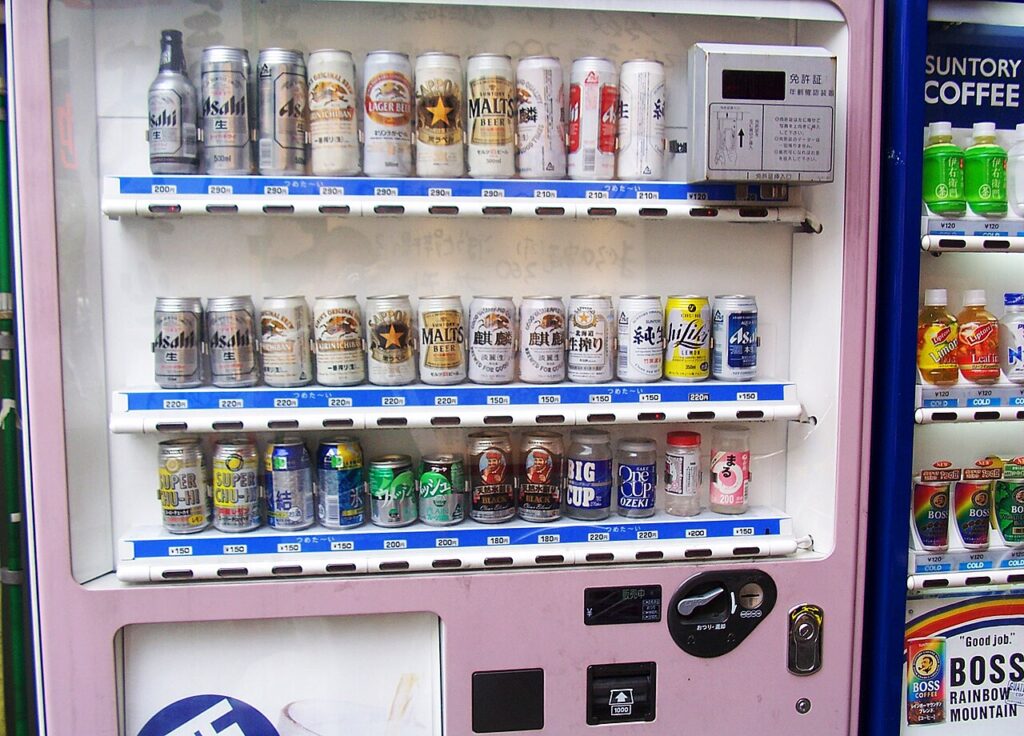
There’s a vending machine outside a shuttered fish shop in a small Niigata town. It sells hot canned coffee, two kinds of corn soup, and a sports drink that nobody seems to buy. The machine hums quietly against the wall, lit up in the dark like a lantern nobody asked for but everyone seems grateful exists. The fish shop has been closed for years. The machine is restocked every Thursday.
Most visitors to Japan notice vending machines the way they notice convenience stores — everywhere, reliable, slightly surreal. But spend enough time walking through residential neighborhoods, rural backroads, and the kind of streets that don’t appear in any travel guide, and you start to realize that these machines are doing something more interesting than selling drinks. They’re telling you exactly where you are.
Why Japan Has So Many Vending Machines
Japan has roughly one vending machine for every 23 people — one of the highest densities in the world. The reasons are practical: low crime rates make unattended cash machines viable, high labor costs make automated retail attractive, and limited retail space in dense urban areas makes small-footprint selling sensible.
But the practical explanation only goes so far. What it doesn’t explain is the texture of how these machines are distributed — or what their contents say about the people around them.
In Tokyo’s Shibuya or Shinjuku, machines cluster near train exits selling everything from cold brew to energy drinks aimed at office workers running on four hours of sleep. In a quiet residential block in Yanaka, a single machine sells hot tea and a regional brand of canned juice that you won’t find anywhere else in the city. The machine has been there for thirty years. The elderly woman who lives next door treats it as a kind of fixture, the way someone in another country might treat a corner newsstand.
That machine is not there because of foot traffic data or retail strategy. It’s there because someone put it there a long time ago, and the neighborhood grew around it.
Reading a Neighborhood Through Its Machines
Once you start paying attention, the patterns become genuinely interesting.
Industrial and working-class areas
Near factories and construction sites, machines tend toward high-calorie, high-caffeine options. Canned coffee — particularly the Georgia brand in its classic red-and-gold can — dominates. You’ll find calorie mate-style drinks, sports beverages in large formats, and occasionally hot soup in winter. These aren’t aesthetic choices. They reflect who’s standing in front of the machine at 6 a.m. and what they need before a long shift.
Older residential neighborhoods
In established shitamachi-style neighborhoods — the older, low-rise residential areas that still exist in pockets of Tokyo, Osaka, and many regional cities — machines often stock a narrower, quieter selection. Hot green tea, canned coffee, maybe a barley tea. Nothing flashy. The machines themselves are sometimes older models, the kind with physical buttons rather than touchscreens, the product photos sun-faded to a gentle blur. These machines weren’t chosen to appeal to passersby. They were placed to serve the people who live within a two-minute walk.
Near temples and shrines
Machines positioned near religious sites follow a different logic. You’ll often find cold water and tea available, sometimes at slightly lower prices than elsewhere — a small accommodation to the fact that people visit these places for quiet, not stimulation. In some rural shrine approaches, a single machine stands alone at the edge of a gravel path, the only sound around it the wind and the occasional crow. Nobody is trying to sell you anything aggressively. The machine is just there, the way a water basin is just there.
The Machine as a Measure of Rural Decline
In depopulating rural towns — and there are many, particularly in Tohoku, the Chugoku region, and parts of Shikoku — vending machines sometimes outlast the businesses that originally placed them. A machine outside a closed pharmacy. A machine in front of a shuttered post office. A machine at a bus stop that sees two buses a day.
These machines are restocked because the contracts still exist, because a distributor still drives the route, because someone in an office somewhere hasn’t gotten around to pulling the plug. But they also persist because they’re needed. In a town where the nearest convenience store is a twenty-minute drive, a vending machine outside the old community hall is not a curiosity. It’s infrastructure.
This is something worth sitting with. The same object that reads as novelty in Harajuku reads as lifeline in a village in Akita. The machine doesn’t change. The context does everything.
Walking through rural Japan, where the rhythm of daily life moves at a pace that urban Japan has largely forgotten, you start to understand why these machines feel different. They’re part of the same quiet social fabric you notice in other places — in the handwritten announcements on community bulletin boards, for instance, the kind described in How to Read a Japanese Neighborhood Notice Board (Without Speaking Japanese). Both are small, easily overlooked, and surprisingly revealing once you start paying attention.
Seasonal Changes and What They Signal
Japanese vending machines switch between hot and cold offerings based on the season, and the timing of that shift is something locals notice even when they don’t consciously track it.
Sometime in October, the hot drinks return. Canned coffee that was cold the week before is now warm. Corn soup reappears. The machine hasn’t changed, but the season has, and the machine has adjusted accordingly — quietly, without announcement.
There’s something very Japanese about this. The acknowledgment of seasonal change isn’t dramatic here. It doesn’t need to be announced or celebrated. It simply happens, and the people who use the machine notice it the way they notice the first persimmons appearing at the greengrocer, or the shift in the quality of afternoon light.
For a traveler moving through Japan in autumn or early spring, these small transitions are worth watching. The moment a machine switches its hot drinks on is a more honest seasonal marker than any tourist calendar.
A Few Things Worth Knowing Before You Start Paying Attention
- Most machines accept IC cards like Suica or Pasmo in addition to coins and bills, making them genuinely useful rather than just interesting to look at.
- In rural areas, prices are sometimes lower than in cities — a reflection of lower operating costs and a different relationship with the customer base.
- Some machines in smaller towns or near community facilities are operated by local organizations rather than major distributors. The profits go back into the neighborhood.
- Specialty machines — selling sake, fresh eggs, local produce, ramen, or even flowers — exist but tend to be regional. Finding one is usually an accident, which is part of what makes them worth noticing.
- The sound a machine makes when it accepts your money and delivers a can is remarkably consistent across the entire country. It’s one of the more quietly comforting sounds in Japan.
What You’re Actually Seeing
Japan rewards the kind of attention that most travel doesn’t encourage. The country is easy to move through quickly, and the infrastructure is so good that it’s entirely possible to visit for two weeks and never feel disoriented, never feel the need to slow down and look at what’s actually around you.
But the places that stay with people — the experiences that feel genuinely different from anything back home — tend to come from exactly that kind of slowing down. From noticing the machine at the end of a quiet street in a town you didn’t plan to stop in. From wondering who restocks it, who drinks from it, what the neighborhood looked like when it was first installed.
That curiosity is the same one that draws thoughtful travelers to Yamagata’s Mogami River towns or along the back roads of regions where the infrastructure of daily life is still visible in ways that cities have long since smoothed over.
The vending machine isn’t the point. It’s just a good place to stop, look around, and ask what kind of place this actually is — and who lives here, and what they need at the end of a long day.
The machine hums. Someone’s answer to that question is already loaded inside it.