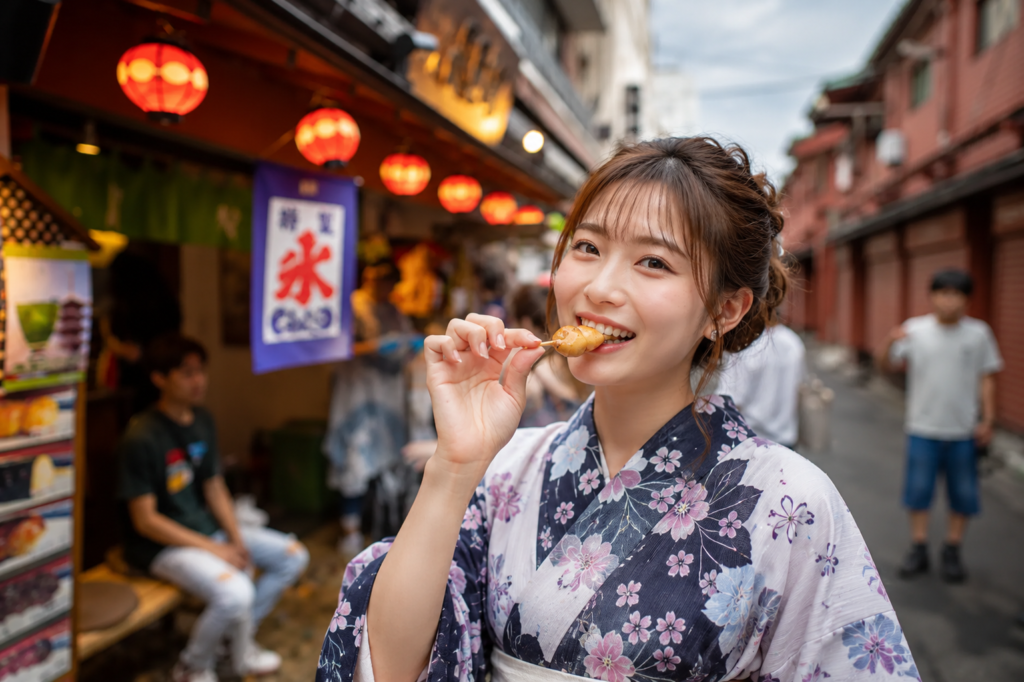
You bought the taiyaki from the street stall. It is warm, it smells extraordinary, and you are standing in the middle of a narrow shopping street in Kamakura with nowhere obvious to sit. So you start walking and eating, because that is what you do, because why wouldn’t you, because there is nothing in your entire cultural background that has ever suggested this was a problem.
Three people look at you. Not hostilely. Just — briefly, precisely, in a way that contains a complete sentence.
You have just discovered tabearuki (食べ歩き) — the act of eating while walking — and the quiet but firm Japanese consensus that it is, in most contexts, not something one does.
This will surprise you, particularly if you’ve just come from a country where eating on the go is so normalized that there are entire product categories designed around it. It surprises most visitors. And the explanation is interesting enough that it’s worth understanding rather than simply memorizing as a rule.
It’s Not Actually a Law. Mostly.
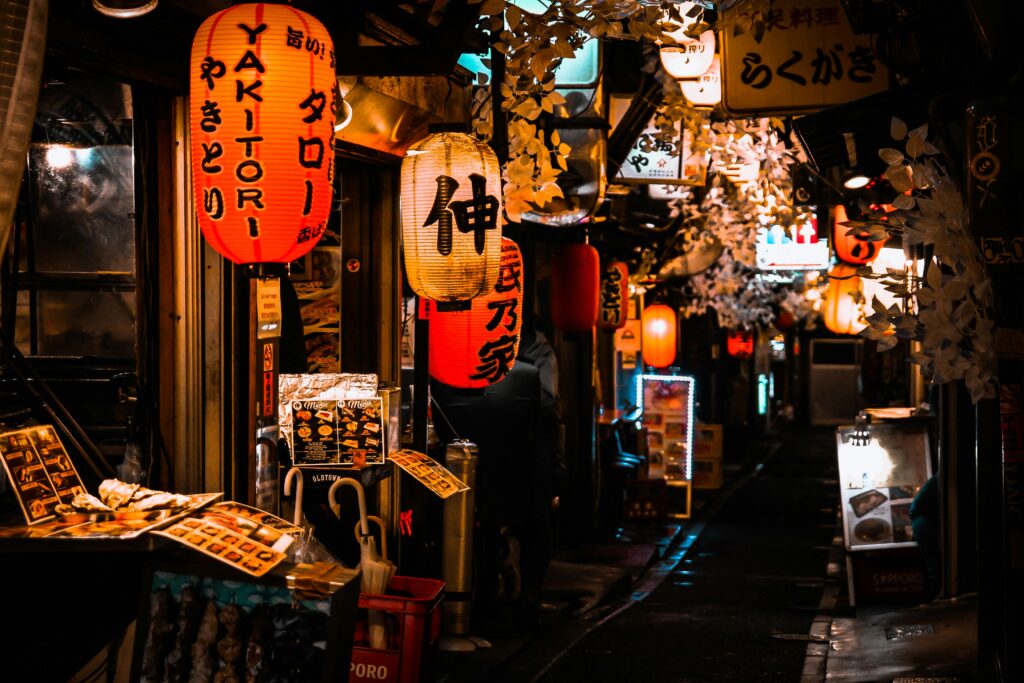
Before the cultural explanation, a practical clarification: tabearuki is not universally prohibited in Japan. Street food exists — yatai (屋台) stall culture is ancient and legitimate, and nobody is going to arrest you for eating a yakitori (焼き鳥) skewer while standing in a festival crowd. The Tsukiji outer market is built around the assumption that people will eat while standing still. Convenience store onigiri (おにぎり) are consumed on every platform in the country.
The distinction the Japanese make is subtle but consistent: eating while stationary is generally acceptable. Eating while moving through shared space is the thing that reads as inconsiderate. The difference is between pausing to eat and treating the street as your dining room while other people are trying to use it.
Some places have made it official. Kyoto’s Ninenzaka preservation district introduced guidelines against street eating in 2019, partly in response to tourism pressure. Kamakura has similar informal expectations around its main shopping street. These are specific responses to specific overcrowding problems, but they draw on a broader cultural logic that predates tourism entirely.
The Logic Underneath
To understand why moving-while-eating reads as inconsiderate in Japan, you need to understand the Japanese concept of meiwaku (迷惑) — the act of causing inconvenience or trouble to others. Meiwaku is one of the more powerful social concepts in Japanese daily life, and its scope is broader than the English word “inconvenience” suggests.
Meiwaku covers noise, mess, unpredictability, and anything that disrupts the shared experience of a public space. Eating while walking scores on several of these dimensions simultaneously: it produces wrappers and crumbs in shared spaces, it makes the eater’s movements less predictable, and — perhaps most importantly — it signals a certain inattention to the social environment. You are, in a sense, prioritizing your own hunger over your awareness of and responsibility to the space you’re moving through.
“In Japan, public space is understood as shared in a way that makes your private appetite feel like an imposition.”
This connects to a broader principle visible throughout Japanese public life: the subway is quiet because your phone call is meiwaku to other passengers; the trash goes in your bag because a street without bins is a social contract about who cleans up; the umbrella gets folded at the door because dripping water is meiwaku to the floor and everyone who walks on it after you. These are not arbitrary rules. They share a common logic about the relationship between the individual and the shared environment.
The Historical Layer
There is also a historical dimension that occasionally gets overlooked. For most of Japanese history, food was neither cheap nor casual. Preparing a meal was labor-intensive, ingredients were not abundant for ordinary people, and eating was an activity that warranted stillness and attention. The concept of itadakimasu (いただきます) — said before eating, meaning roughly “I humbly receive” — reflects a relationship with food that is fundamentally one of gratitude and respect.
Eating while doing something else, from this perspective, is not just inconsiderate to other people. It is slightly disrespectful to the food itself. You are not giving it your attention. This sounds abstract until you watch someone in Japan eat a convenience store sandwich — alone, at a small counter, looking at nothing in particular — with a quality of presence that most Western diners reserve for restaurants.
| Behavior | Context | Generally acceptable? |
|---|---|---|
| Eating at a yatai stall | Festivals, markets | Yes |
| Eating while walking | Any public street | Generally no |
| Eating on the shinkansen | Long-distance trains | Yes |
| Eating on local trains | Commuter trains | Generally no |
| Eating at a station platform bench | Stations | Yes |
| Drinking from a vending machine can | Street, while standing | Yes |
The Exceptions That Prove the Rule
Japan is not, it should be noted, a country without contradiction. Konbini culture has produced an entire ecosystem of portable food explicitly designed to be eaten on the go — onigiri, sandwiches cut into triangles, nikuman (肉まん) steamed buns handed through a small hatch at the FamilyMart counter. The country has a genuine tradition of ekiben (駅弁), elaborate boxed meals sold at train stations specifically to be eaten on long-distance trains.
The shinkansen (新幹線) is the clearest exception: eating on the bullet train is not just acceptable but practically expected, and station bento culture is one of the more quietly extraordinary aspects of Japanese food life. The logic here is that you are seated, contained, and not moving through shared pedestrian space — the conditions that make eating acceptable are present.
The contradiction resolves itself when you apply the underlying principle rather than trying to memorize a list of rules. The question is not can I eat here but am I, by eating here, making this space worse for the people around me.
The Thing No Guidebook Says
Most travel writing about tabearuki presents it as a rule to follow, which is accurate but incomplete. The more interesting thing is what happens when you internalize the logic rather than just the instruction.
Once you understand meiwaku — really understand it, not as a Japanese quirk but as a coherent philosophy about shared space — you start to see it operating everywhere in Japan, and you start to see its absence everywhere you’ve been before. The subway that’s quiet because everyone decided it should be. The street that’s clean because everyone decided it should be. The queue that works because everyone decided it should work, without enforcement, without signage, without anyone asking.
The no-eating-while-walking norm is not really about food. It is a small, daily expression of a much larger idea: that public space belongs to everyone using it, and that your presence in it carries a responsibility to the people around you. Eat your taiyaki standing still, in front of the stall, and you are not following a rule. You are participating in a consensus.
It tastes the same either way. Possibly better.
Itadakimasu.