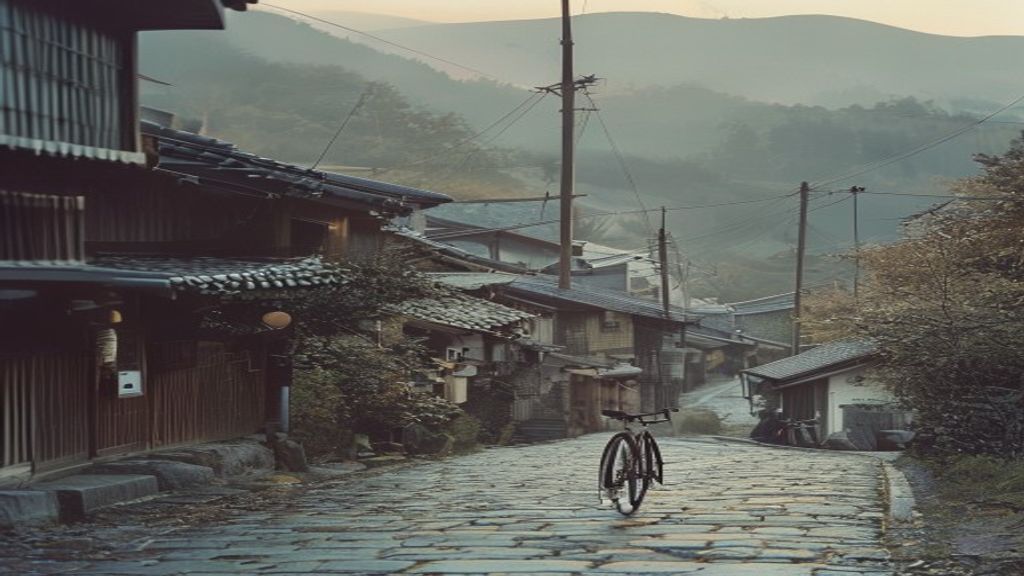
There is a village in Nagano Prefecture called Magome where the stone-paved path climbs steeply between wooden buildings and the whole thing looks almost too composed, like a film set that forgot to add the film crew. It is beautiful. It is also, in a specific and melancholy way, a performance of something that no longer exists. The real story of the *nakasendo* (中山道) — the inland mountain highway that once connected Edo to Kyoto — is not the restored stretch between Magome and Tsuma-juku that every travel blog has photographed. It is the dozens of other宿場町, *shukubamachi* (宿場町), post towns, that nobody restored. The ones that just kept going until they didn’t.
I walked a longer section of the Nakasendo than most people bother with, not because I am particularly virtuous about travel, but because I had time and a mild obsession with what infrastructure decay looks like when a country moves fast and forgets to look back. What I found was less a hiking trail and more an argument about memory — about which pieces of history a society decides to keep alive and which it lets go quietly in the rain.
## When the Train Came and the Road Stopped Mattering
The Nakasendo was one of the five major highways of the Edo period, maintained by the Tokugawa shogunate with bureaucratic seriousness. Post towns were spaced roughly a day’s walking distance apart. They had official inns, *honjin* (本陣), reserved for daimyo and government officials, and slightly less official inns for everyone else. The whole system was a kind of pre-industrial logistics network, and it worked because there was no alternative.
Then the Meiji government came, and then the railways came, and then the alternative arrived. The Chuo Line, completed in stages through the late 1800s and early 1900s, ran through the valleys. The Nakasendo ran over the mountains. The math was not complicated. Within a generation, towns that had existed for two and a half centuries as essential nodes in a national transportation network became, essentially, scenic detours on the way to somewhere else.
Some of them adapted. Some of them became farming villages. Some of them just slowly emptied.
## What a Forgotten Post Town Actually Looks Like
I want to be careful not to romanticize this, because the temptation is enormous and also misleading. The abandoned or semi-abandoned post towns along the Nakasendo are not picturesque ruins. They are places where old wooden buildings stand next to corrugated metal sheds, where the original *honjin* site is marked by a small sign that may or may not be legible depending on how long it has been since anyone repainted it, and where the population skews old enough that you feel slightly guilty for being there as a tourist.
> “The post towns that survived did so not because they were historically significant, but because they happened to be near something else — a ski resort, a hot spring, a junction on a newer road. History was not the point. Convenience was.”
This is the thing that the restored stretches obscure. Magome and Tsumago survived because local preservation movements fought hard in the 1960s and 70s to stop development and maintain the streetscape. They are genuine preservation success stories. But they are also exceptional. The default outcome for a post town after the railways arrived was not picturesque stasis. It was slow, undramatic decline — a process that is ongoing in many places right now.
## The Architecture That Stayed
What does persist, even in the forgotten towns, is the architecture of function. The buildings that remain tend to be the ones that were built to last — thick earthen walls, heavy tiled roofs, wooden beams that were never going to be replaced cheaply. The structural logic of an Edo-period inn or merchant house turns out to be more durable than the economic reason for its existence.
| Town | Status | What Remains |
|—|—|—|
| Magome-juku | Fully restored | Cobbled street, working inns, tourist infrastructure |
| Tsumago-juku | Fully restored | Preserved streetscape, honjin museum |
| Niekawa-juku | Largely forgotten | A few original buildings, small signage, no tourists |
| Nirasaki-juku | Absorbed into modern town | Stone markers, one restored building facade |
| Shimo-Suwa-juku | Partially active | Onsen town, some original structures in use |
Shimo-Suwa is an interesting case. It survived partly because it sat on a hot spring, which meant it had something to offer travelers even after the walking traffic dried up. If you are curious about how onsen culture kept certain towns economically viable long after their original purpose disappeared, the logic is not so different from what I described in [Kyuri’s No-Nonsense Guide to Picking the Perfect Onsen Ryokan](https://www.urajapanblog.com/kyuris-no-nonsense-guide-to-picking-the-perfect-onsen-ryokan-even-if-its-your-first-time/) — the bath was never just the bath. It was the reason to stop.
## Walking the Unrestored Parts
If you want to actually understand the Nakasendo rather than just photograph the famous kilometer of it, the approach is straightforward: walk between the towns that nobody talks about. The path still exists, marked by small stone signs and occasional wooden posts, passing through cedar forests and over mountain ridges that the railway tunneled through and the highway bypassed entirely. For longer, more serious route planning on old Japanese highways, [Kyuri’s Guide to the Tokaido](https://www.urajapanblog.com/kyuris-guide-to-the-tokaido-walking-japans-old-post-towns-from-edo-to-kyoto/) covers the sister route in more detail and the planning logic applies here too.
The walking is not difficult by any serious hiking standard. What it requires is a tolerance for ambiguity — for arriving in a town and finding that the historical marker is behind a vending machine, or that the most intact building on the old highway is now a storage facility for agricultural equipment.
## The Thing No Guidebook Says
The restored post towns are real. The preservation is genuine. But they have also become, paradoxically, the least honest version of what the Nakasendo was — because the actual road was never a museum. It was a place where people lived and worked and got rained on and complained about the price of rice. The towns that were not restored are closer to that reality, even in their decay. Especially in their decay.
History in Japan is not uniformly preserved. It is selectively rescued, and everything else is left to become something else quietly. That process is worth looking at directly.
*Zanzo (残像)*