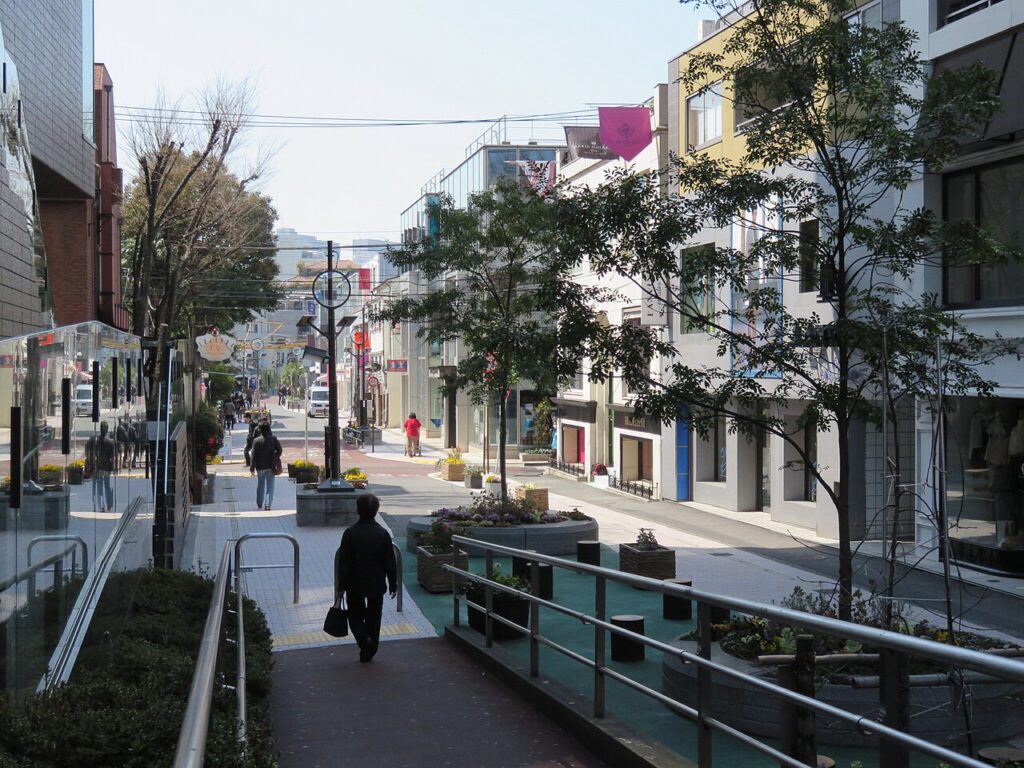
Most visitors to Yanaka arrive looking for the living. They come for the shotengai — that long, unhurried shopping street where fish sellers and tofu shops and old women with cloth bags still coexist in a way that most of Tokyo quietly abandoned decades ago. They photograph the wooden houses and the narrow lanes and feel, correctly, that they’ve found something Tokyo doesn’t often show.
But the real Yanaka is older than its shopkeepers. It runs deeper than its architecture. And to understand what makes this neighborhood different from anywhere else in the city, you have to walk into its cemeteries.
Why Yanaka Has So Many Cemeteries in the First Place
The concentration of burial grounds here isn’t accidental. During the Edo period, the Tokugawa shogunate deliberately relocated many of Tokyo’s temples — and the cemeteries attached to them — to the elevated terrain north of the city center. The reasoning was practical: hills meant better drainage, and temples meant land that couldn’t be easily redeveloped for commercial use. Yanaka became, in effect, a buffer zone of the dead surrounding a city of the living.
When the Great Kanto Earthquake leveled much of Tokyo in 1923, and American firebombing reduced vast swaths of the city to ash in 1945, Yanaka survived both catastrophes largely intact. The cemeteries, paradoxically, helped save the neighborhood. Wide open burial grounds don’t burn the way wooden houses do. They acted as firebreaks, and the buildings that sheltered in their shadow survived.
So when you walk through Yanaka today and feel that strange sense of continuity — that this place hasn’t been entirely erased and rebuilt like the rest of the city — you’re feeling the consequence of the dead protecting the living. That’s not metaphor. That’s urban history.
Yanaka Cemetery: What You’re Actually Walking Through
Yanaka Reien, the main cemetery, covers about 100,000 square meters in the center of the neighborhood. That’s a significant piece of central Tokyo given over entirely to graves, old trees, and the particular silence that settles over well-tended burial grounds.
The main avenue through the cemetery is lined with cherry trees — around 200 of them — and in spring it becomes one of the city’s better-known hanami spots. But even that experience is different here than in parks like Ueno. People spread out blankets between the grave markers, eating and drinking in the presence of the dead without any apparent discomfort. This is worth pausing on.
In Japanese Buddhist tradition, death isn’t something to be kept at a careful distance. The dead remain part of the community. Obon, the summer festival observed across Japan, exists specifically to welcome the spirits of ancestors back home for a few days each year. Sitting under cherry blossoms in a cemetery isn’t morbid in the Japanese cultural framework — it’s continuous with a very old understanding of what community means, and who belongs to it.
The Grave of the Last Shogun
Tokugawa Yoshinobu, the fifteenth and final shogun of the Edo period, is buried in Yanaka Cemetery. His grave is modest by the standards of what you’d expect for a man who once held absolute power over Japan. A simple headstone, well-maintained, sitting in a section of the cemetery that doesn’t announce itself. There are no dramatic monuments, no plaques explaining his significance to passing visitors.
He died in 1913, having outlived the entire world he once governed. After the Meiji Restoration ended his rule in 1868, he retreated into private life, took up photography and cycling and painting, and lived quietly into old age. That a man who presided over the collapse of feudal Japan should end up in a neighborhood cemetery in a city that barely remembers his name feels like a very Japanese kind of resolution.
Reading the Graves Themselves
For those willing to slow down, the grave markers in Yanaka tell compressed versions of Tokyo’s social history. Older stones, darkened and tilted slightly by a century or more of settling ground, often bear family crests carved into their surfaces. These kamon — hereditary symbols used by samurai families and eventually adopted more broadly — are a kind of visual archive of who once mattered in Edo society.
More recent graves reflect the shift toward smaller family units. Where older plots might accommodate multiple generations under one large stone, newer sections show individual graves, sometimes with photographs of the deceased set behind small glass panels in the stone itself. The transition from clan to individual, compressed into a few hundred meters of cemetery ground.
The Smaller Temple Cemeteries Hidden in the Side Streets
Yanaka Reien gets most of the attention, but the neighborhood is threaded with smaller temple cemeteries that most visitors walk past without registering. There are more than seventy temples in the Yanaka area — an extraordinary density even by Tokyo’s standards — and many of them maintain small, enclosed burial grounds that are technically open to the public during daylight hours.
Tennoji is one worth entering. The temple itself dates to the 14th century and the cemetery behind it has that quality of deep quiet that comes from centuries of accumulated stillness. Moss grows on the older stones in a way that suggests the ground here has been undisturbed long enough for nature to start reclaiming it at the edges.
These smaller cemeteries feel genuinely private in a way that the main cemetery doesn’t. Walk in respectfully, move slowly, and you’ll be left alone. Photography is generally acceptable in Japanese public cemeteries, but pointing a camera directly at individual grave markers — especially newer ones — crosses into territory that doesn’t need crossing. The rule of thumb is to photograph the atmosphere, not the names.
What the Cemeteries Reveal About Yanaka’s Relationship with Time
Tokyo is a city with an unusual relationship with its own past. Whole neighborhoods get demolished and rebuilt within a generation. Buildings that might be considered heritage elsewhere get replaced without ceremony. The city moves fast, and it doesn’t often look back.
Yanaka doesn’t work that way, and the cemeteries are part of why. Land attached to temple grounds is difficult to redevelop under Japanese law and custom. The graves themselves create a kind of legal and cultural anchor — you can’t build a convenience store on top of someone’s grandmother. So the cemeteries have preserved not just their own ground but the streets and wooden buildings and old shops that grew up around them over centuries.
The neighborhood’s famous resistance to modernization isn’t nostalgia. It’s structural. The dead have been holding the neighborhood in place all along.
Practical Notes for Visiting
Getting There
Yanaka is accessible from Nippori Station on the JR Yamanote Line, or from Sendagi Station on the Tokyo Metro Chiyoda Line. From Nippori, you’re essentially dropped at the edge of the cemetery. From Sendagi, you approach through the backstreets, which is the better entrance if you want to feel the neighborhood before you find the graves.
When to Go
Early morning is the best time, especially on weekdays. The cemetery is quiet, the light comes through the trees at a low angle, and you’ll often have long stretches of the main avenue entirely to yourself. Late afternoon in autumn is a close second — the ginkgo trees turn yellow in late November and the low sun catches the older stones in a way that’s worth seeing.
Spring cherry blossom season is genuinely beautiful but noticeably more crowded. It’s worth coming then, but adjust your expectations accordingly. The solitude disappears, replaced by something more festive — which is, in its own way, appropriate to the setting.
How Much Time to Allow
A thorough walk through Yanaka Reien and one or two of the smaller temple cemeteries takes about ninety minutes at an unhurried pace. Combine it with the Yanaka Ginza shopping street and a meal at one of the older neighborhood restaurants, and you have a full half-day that most Tokyo itineraries don’t include.
A Neighborhood That Asks a Different Kind of Attention
Yanaka rewards a particular kind of traveler — one who’s comfortable with slowness, who finds meaning in ordinary details, who doesn’t need constant stimulation to feel that a place is worth their time. The cemeteries ask you to be quiet, to look carefully, and to consider that the most interesting thing about a neighborhood might not be what it sells or what it looks like, but what it has chosen to preserve and why.
There’s a stone in Yanaka Cemetery that I’ve walked past several times without ever learning whose it is. The carving has worn smooth, the family crest is almost gone, and the incense holder in front of it is clean and recently used. Someone still comes. Someone still remembers. In a city that rebuilds itself every thirty years, that kind of continuity is its own quiet argument for paying attention.