Vending machines in Japan are not a tourist attraction you need to chase down. They are simply one of the easiest ways to buy a drink when you are between stations, walking through a residential area, or arriving somewhere after the shops have closed. The system is simple once you know the labels, the payment options, and what to do with the bottle afterward.
This is the practical guide. If you are more interested in what a machine’s location and drink selection can reveal about the neighbourhood around it, read how to read a Japanese neighbourhood through its vending machines.
How to buy a drink
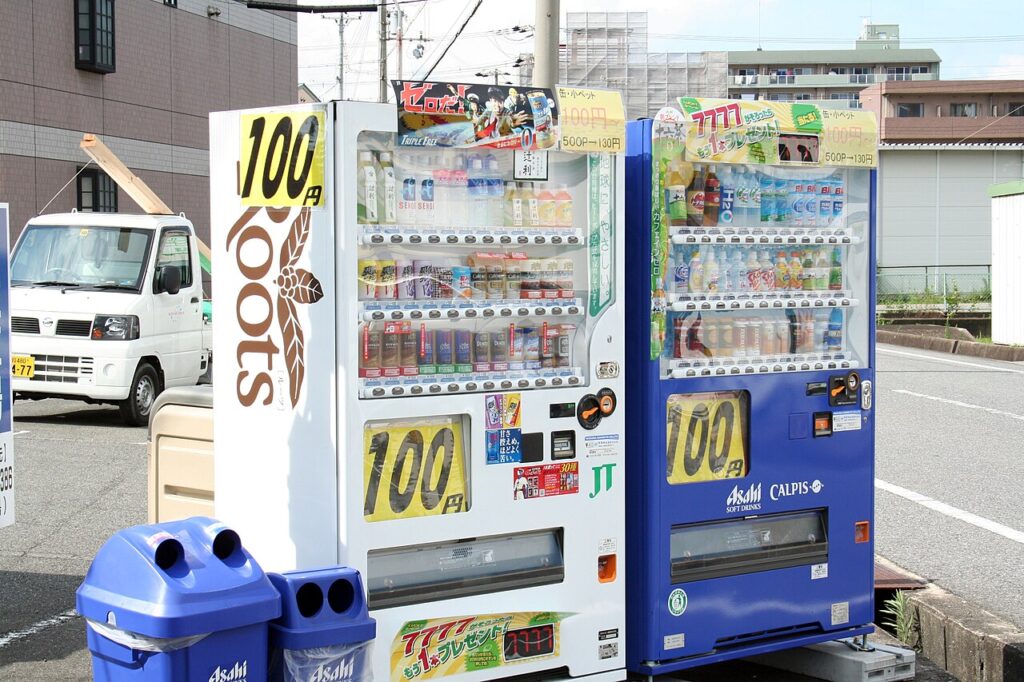
Choose your drink first, then check the price under the button. Insert coins, a bill, or tap a supported IC card. When the purchase is accepted, the selection buttons that you can afford usually light up. Press the button once, wait for the drink to drop into the collection tray, then take your change.
Most modern machines accept 10, 50, 100, and 500 yen coins, and many accept 1,000 yen notes. Larger notes are less consistently accepted. IC cards such as Suica, PASMO, ICOCA, and their mobile equivalents are often the quickest option, although support is not universal—especially in rural areas or at older machines.
Hot or cold? Read the colour before you press
Japanese machines commonly sell the same type of drink at different temperatures. A blue label or blue-lit button generally means cold. A red label or red-lit button generally means hot. This is especially important for canned coffee, tea, and corn soup. A drink that looks like an ordinary can may be surprisingly hot, so let it cool for a moment before putting it in a bag.
The selection changes through the year. Hot drinks usually appear in autumn and winter; cold drinks return in spring. You may also see seasonal flavours, regional juices, or a local tea brand that is hard to find elsewhere.
Useful Japanese words on a machine
- あたたかい / 温かい — hot or warm
- つめたい / 冷たい — cold
- お茶 — tea
- 水 — water
- コーヒー — coffee
- スポーツドリンク — sports drink
- 売り切れ — sold out
Where vending machines are genuinely useful
Near major stations, a machine is mostly a convenience. In smaller towns, hiking areas, and quiet residential districts, it can be the only easy place to find a drink for some distance. Do not assume there will be one exactly when you need it, though. Carry water when you are walking a rural route, exploring in summer, or travelling between infrequent local trains.
Some machines sell more than drinks: ice cream, fresh eggs, rice, local produce, sake, or hot food. These are not guaranteed attractions. Treat them as a useful surprise rather than a reason to plan a day around one.
Where to put the empty bottle or can
Many machines have a recycling bin beside them. Use it for the drink container you have just finished, not as a general rubbish bin. If there is no bin, keep the container until you find a suitable recycling point at a station, convenience store, or your accommodation. Public bins can be scarce, so carrying a small bag for your rubbish is normal and considerate.
Small points of etiquette
There is no ritual to buying from a machine. Just avoid blocking a narrow pavement, especially near a station exit, and do not leave empty cans on top of the machine or beside the bin. If a machine takes your money without dispensing a drink, look for a contact number printed near the coin slot; in practice, it is often easier for a short-term visitor to choose another machine and keep moving.
Once you are comfortable using them, vending machines stop feeling unusual. They become part of the background infrastructure that makes a long day of travelling in Japan much easier.