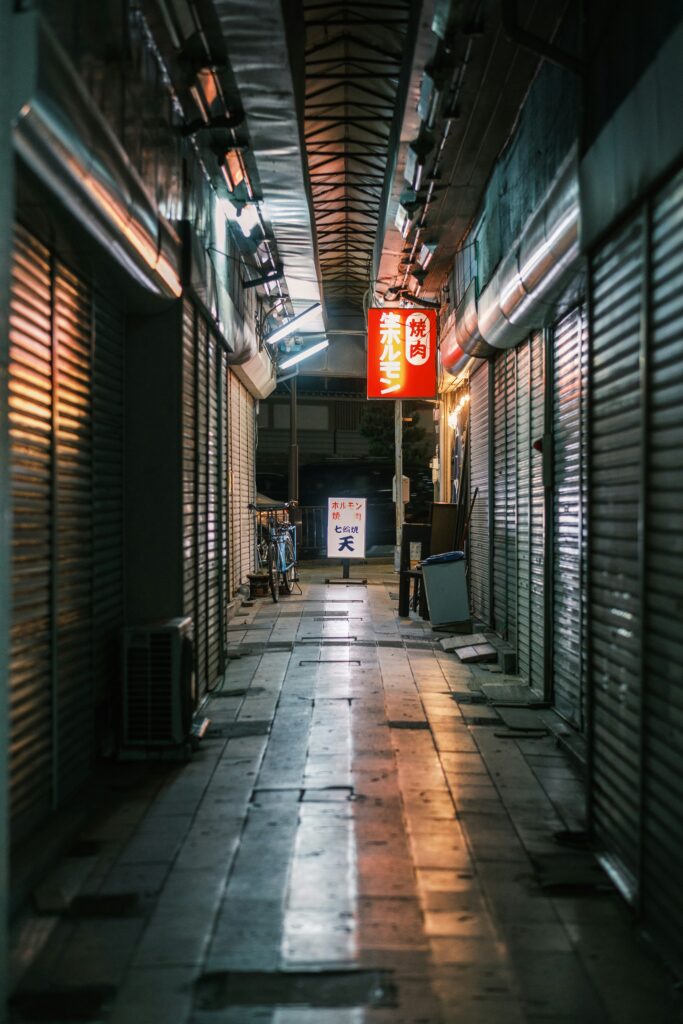
You are standing under a neon sign that hasn’t flickered in twenty years. To your left, a fishmonger is carefully packing ice around a single sea bream. To your right, an elderly woman in a floral apron is frying potato croquettes in a deep vat of oil. This is the shotengai (商店街) — Japan’s traditional shopping streets.
To the average tourist, Tokyo is a city of hyper-modern high-rises and neon crossings. But the real heartbeat of the city lies in these covered arcades. Many of them are dying, their shutters closed permanently as convenience stores and massive shopping malls take over. Yet, to walk through a fading shotengai is to step into a version of Japan that is quietly, stubbornly holding on.
What It Is
A shotengai is more than just a street; it is a community living room. Typically located near local train stations, these streets were designed for daily life. Before supermarkets existed, residents would walk down the shotengai every afternoon to buy fresh tofu, vegetables, meat, and household goods.
Today, walking through one is a sensory experience. You hear the rhythmic call of the vegetable seller, smell the sweet aroma of roasting green tea (hojicha), and feel the warmth radiating from the small, open-front shops. The architecture is a patchwork of mid-century concrete, corrugated tin, and faded plastic awnings. It is messy, human-scaled, and entirely unpolished.
“A shotengai is where the polished veneer of modern Japan falls away, revealing a community that still knows each other’s names.”
Why It Works for Travelers
If you want to understand the rhythm of daily Japanese life, you cannot find it in Shibuya or Shinjuku. You find it here, around 4 PM, when mothers are buying ingredients for dinner and school children are stopping for a snack.
There is no pressure to buy. You can wander slowly, munching on a ¥150 croquette, watching the interactions. The shopkeepers are often elderly, fiercely proud of their craft, and surprisingly eager to chat with anyone who shows an interest. It is a space where you are allowed to slow down and observe the quiet machinery of Japanese society.
Three Fading Shotengai to Explore
1. Joyful Minowa (Tokyo)
Located at the end of the historic Toden Arakawa tram line. It is a covered arcade that feels frozen in the Showa era. Go for the cheap street food and the incredibly friendly locals.
2. Togoshi Ginza (Tokyo)
One of the longest shotengai in Tokyo. While more popular than Minowa, it still maintains its neighborhood feel. It is famous for its “croquette walk” — dozens of shops selling unique fried snacks.
3. Kyojima (Tokyo)
An area that survived the bombings of World War II. The streets are incredibly narrow, winding, and filled with old wooden houses and tiny, independent shops.
Essential Vocabulary
| Japanese | Romanization | Meaning |
| 商店街 | Shotengai | Traditional shopping street |
| コロッケ | Korokke | Potato croquette — the ultimate shotengai snack |
| 昭和 | Showa | The historical era (1926–1989) associated with nostalgic Japan |
| 惣菜 | Sozai | Side dishes sold in open-front shops |
The Thing No Guidebook Says
The standard advice for visiting Tokyo is to look forward — to see the latest technology, the newest cafes, the trendiest fashion. But the most rewarding experiences in Japan often come from looking backward.
The shotengai are not tourist attractions; they are endangered species. Every year, more shutters go down, replaced by sterile apartment blocks or chain pharmacies. When you visit a shotengai, you are witnessing a lifestyle that is actively disappearing. Don’t just take photos. Buy a croquette, say hello to the shopkeeper, and spend your yen where it actually supports a local family.
Otsukaresama.
To see the other side of this story, read Japan’s Shotengai: The Covered Shopping Streets That Refuse to Disappear.