
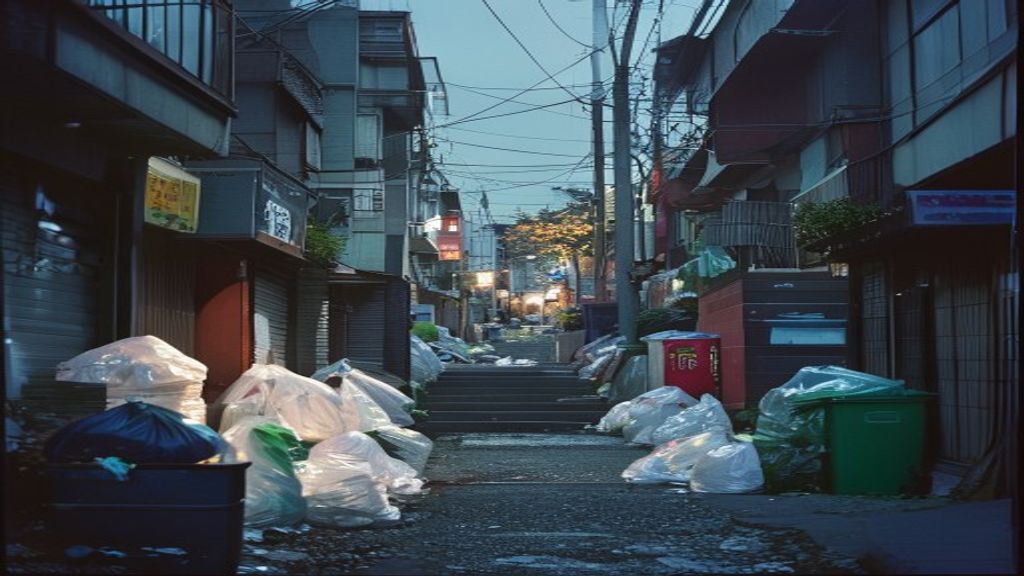
Your neighbor watches you. Not in a hostile way — more like a librarian watching someone handle a rare book wrong. You moved into your apartment in October, arranged your furniture, figured out the shower pressure, located the nearest convenience store. Then Tuesday morning came, and you put your bag of kitchen waste next to the designated collection point in a clear plastic bag. By the time you left for work, the bag was back outside your door with a small orange sticker on it. No note. No explanation. Just a sticker, like a failing grade from a teacher who has given up on you.
This is gomi no hi (ゴミの日) — garbage day — and it is the single most quietly enforced social contract in Japanese residential life. Get it right and nobody notices you. Get it wrong and you have introduced yourself to every household within fifty meters more effectively than any neighborhood welcome event ever could.
The rules are not intuitive. They are also not consistent across cities, or across wards within the same city. What Setagaya-ku accepts on a Wednesday, Nerima-ku rejects on a Friday. What Osaka calls non-burnable, Kyoto sometimes categorizes differently. The Japanese government has, to its credit, created one of the most sophisticated waste management systems in the world. It has also, to your inconvenience, distributed the instruction manual in Japanese, in small print, and made it different everywhere.
How to Read Your Neighborhood Garbage Calendar
When you move into an apartment, your landlord or building manager will hand you a gomi karendā (ゴミカレンダー) — a monthly or annual collection schedule specific to your local district. This is not symbolic paperwork. It is a document you will need to reference regularly, at least until the schedule becomes muscle memory.
Tokyo’s 23 wards each operate their own waste collection system under the Tokyo Bureau of Environment. Shinjuku-ku, Shibuya-ku, and Minato-ku all have different pickup days and sometimes slightly different sorting categories. Osaka collects burnable waste three times a week in most neighborhoods, which surprises people used to the twice-weekly Tokyo rhythm. Kanagawa Prefecture, which covers Yokohama and Kawasaki, runs a city-level system and Yokohama’s sorting guidelines are notoriously granular — the city’s official sorting handbook runs to over 500 item categories.
If you are renting and your landlord handed you a calendar in Japanese you cannot read, or if you simply lost it, every ward and city publishes its collection schedule online. Search your ward name in romaji plus “garbage calendar” and you will find it. Most Tokyo wards now offer English-language versions. For your physical setup at home, Bilingual Japanese Garbage Calendar Stickers (burnable/non-burnable/PET icons) are a practical purchase for anyone renting long-term — they go directly on your bins so you are not second-guessing at 7am.
Sorting Rules: Burnable, Non-Burnable, PET, and the Regional Quirks
The core categories are consistent enough that understanding them once gets you most of the way there.
| Category | Japanese Term | Examples | Common Pickup Frequency |
|---|---|---|---|
| Burnable | Moeru gomi (燃えるゴミ) | Food waste, paper, soiled packaging | 2-3x per week |
| Non-burnable | Moenai gomi (燃えないゴミ) | Ceramics, small metal items, glass | 1-2x per month |
| PET bottles | PET botoru (PETボトル) | Drinks bottles (label and cap removed) | 1x per week |
| Cans and bottles | Kan/Bin (缶・瓶) | Aluminum cans, glass bottles rinsed | 1x per week |
| Hazardous | Kiken gomi (危険ゴミ) | Lighters, spray cans, batteries | Varies |
The regional quirks matter more than people expect. In Osaka, plastic packaging often goes into burnable waste rather than a separate plastics category, because Osaka’s incineration facilities are equipped to handle it. In Yokohama, that same plastic packaging goes into a dedicated pura (プラ) recyclable category. If you move between cities, do not assume your Tokyo habits transfer intact.
Food waste — and this is the detail that catches most newcomers — should be drained of moisture before disposal. This is not a suggestion. Excess liquid increases processing costs and weight, and the sorting volunteers at collection points have strong opinions about it.
Sodai Gomi and E-waste: The Pickup That Costs You
Sodai gomi (粗大ゴミ) is large-item waste: furniture, bicycles, appliances that no longer work. You cannot simply leave a broken washing machine next to the collection point and walk away. This is considered illegal dumping and the fine is real.
The standard process involves calling or using your ward’s online ticketing system to schedule a pickup, paying a fee ranging roughly from ¥400 to ¥2,000 depending on item size, purchasing a sodai gomi shori ken (粗大ゴミ処理券) — a waste disposal ticket — from a convenience store, writing your name and pickup date on it, and affixing it to the item on the designated morning. The fee exists because large-item processing requires separate logistics. The ticket system exists because Japan prefers to solve coordination problems with paper stickers.
Electronic waste has its own parallel system under the Home Appliance Recycling Law (家電リサイクル法). TVs, refrigerators, washing machines, and air conditioners are not covered by standard sodai gomi collection. Retailers are legally required to take back old appliances when selling new ones, and there are certified collection points for items purchased elsewhere. Small electronics — old phones, laptops — can often be deposited at manufacturer drop boxes in electronics stores like Yodobashi or Bic Camera.
Staying in an Airbnb, Guesthouse, or Ryokan
Short-stay guests are not expected to navigate the full municipal system — but they are expected not to create problems for their hosts. In most Airbnbs and monthly rentals, the host will specify which bins exist, which bags to use, and crucially, where the collection point is and on which days. Read this information. Actually read it.
“Please do not put garbage outside on non-collection days. The neighbors will see.”
That note, verbatim from a guesthouse in Nakameguro, contains more cultural information than a chapter of any travel guidebook. The collection point is shared communal space. Leaving waste there outside the designated window — even correctly sorted — is an imposition on whoever manages that space and a visual offense to whoever lives nearby.
If you are planning a longer stay and want to avoid the ambiguity entirely, filtering for dedicated monthly rental apartments on Booking.com’s long-stay listings often surfaces places where waste management instructions are explicit upfront, because hosts of long-term properties have learned, usually the hard way, that this is the detail guests get wrong most often.
Packing and Gear for a Long Stay
For stays beyond two weeks in a furnished apartment, a few practical items save daily friction. Japan’s compact apartments rarely come with more than one small bin, which makes pre-sorting at the source genuinely difficult. A 7L Odor-proof Kitchen Bin with Removable Divider is compact enough for a Japanese kitchen counter and lets you separate burnables from recyclables without maintaining two separate containers.
For tracking collection days, the Gomi Navi (ごみナビ) app covers many Japanese municipalities and provides push notifications before collection mornings. The Tokyo Bureau of Environment also has a dedicated sorting app — useful specifically for looking up individual items when you genuinely cannot determine whether a plastic handle counts as burnable or non-burnable. Spoiler: usually burnable.
The Bilingual Japanese Garbage Calendar Stickers mentioned earlier are worth revisiting here. They make more difference than they should, particularly in households where not everyone reads Japanese, and particularly at 6:45am.
For context that goes beyond the logistics — the social layer, the unspoken neighborhood dynamics, the way waste management connects to broader ideas about shared space — a local neighborhood etiquette walking tour that includes a recycling center visit puts all of this into human-scale perspective. The mechanics are learnable from a calendar. The reasoning behind them requires a conversation.
The Thing No Guidebook Says
Every article about Japanese garbage rules focuses on the sorting. The sorting is the easy part. The harder part is understanding that when you put the trash out matters as much as how you sort it.
Collection points in Japanese neighborhoods are not staffed, not locked, and not technically anyone’s property — but they are everyone’s responsibility. Most are managed on a rotating schedule by the households that use them, which means your neighbors are, at some point, cleaning a space that you are also using. Leaving waste out the evening before, even when timed close to collection, signals that you understand the system as a convenience rather than a shared obligation.
The orange sticker you got on your first week’s bag was not about the bag. It was the neighborhood introducing itself back. Japan extends considerable patience to foreigners navigating its systems, but it does not extend patience forever — and the residue of a bad garbage reputation in a residential building follows you longer than you expect.
Get the sorting right. Get the timing right. Nobody will mention it, and that is the point.
Ki wo tsukete (気をつけて)