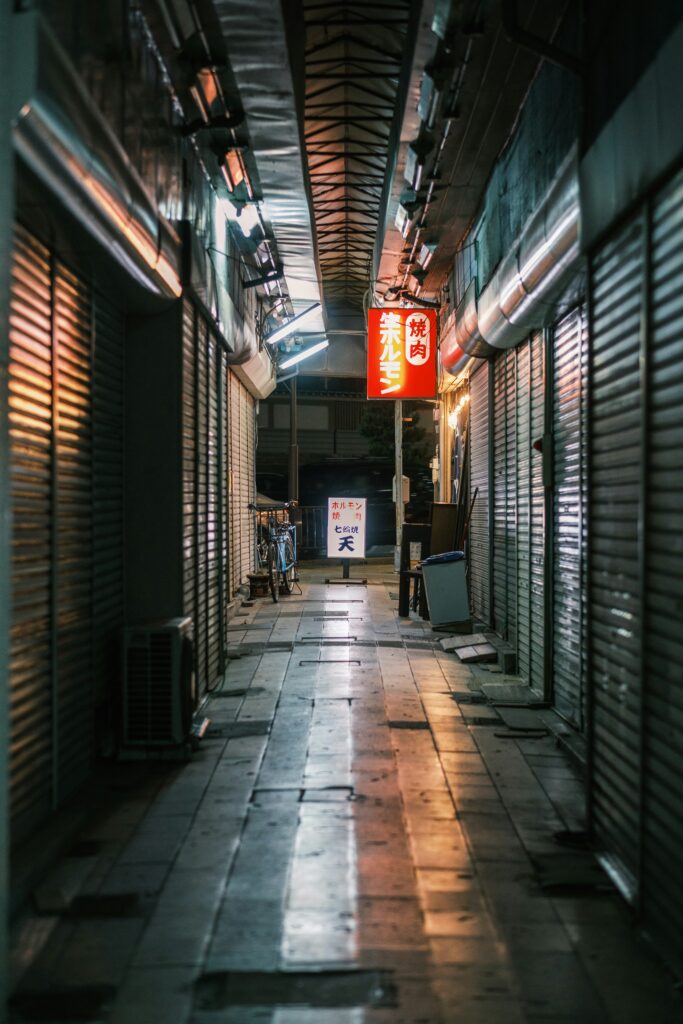

Walk through an older shopping street in Osaka and you’ll sometimes find yourself stepping up — not onto a raised platform or a deliberate design feature, but onto a shop floor that sits noticeably higher than the pavement outside. The gap can be a single step, or several. It isn’t decoration. It’s the visible result of two separate habits layered on top of each other for decades: how Japanese shopfronts were traditionally built, and how Japanese roads are typically repaired. Older districts like Karahori and Nakazakicho, along with scattered backstreets near Shinsekai, are among the easiest places to notice it, because their shopfronts have never been rebuilt to match the street.
The pattern looks strange at first, almost like the street has sunk. In most cases, the opposite is closer to the truth, and once you know why, it’s hard to walk past one of these thresholds without noticing it again.
A Floor Built to Stay Dry, a Road Built to Rise
Traditional Japanese shopfronts and machiya townhouses were built with a raised entrance threshold, a feature sometimes called the agari-gamachi. It kept rain, street mud, and seasonal flooding away from the interior, and it also marked a quiet boundary between the public street and the private, cleaner space inside. Removing shoes at that threshold reinforced the same idea: the floor beyond it belonged to a different, more controlled world than the street. In flood-prone, low-lying cities, builders had good reason to lift the floor even a modest amount above the road, since a few centimeters could be the difference between a dry shop and a ruined one after a heavy rain.
Roads, meanwhile, rarely get rebuilt from scratch. When Japanese municipalities repair asphalt, the common approach is to resurface over the existing layer rather than dig it out and start over. Removing a full road bed is expensive and disruptive to traffic and nearby businesses, so overlaying is faster and cheaper. Each resurfacing adds a thin new layer on top of the old one. Done once, it’s unnoticeable — a centimeter or two makes no difference to how a street feels underfoot. Repeated across many decades, especially on streets that see heavy pedestrian and delivery traffic, it can raise the road’s actual grade by a meaningful amount. A shopfront built with a modest threshold forty or fifty years ago may now sit well above a street that has quietly climbed toward it, repaving after repaving.
Put those two habits together — a floor raised on purpose, a road raised by accumulation — and you get the uneven relationship visitors sometimes notice without being able to explain it. Neither habit is unique to Osaka, but the city has a few reasons for showing the effect more plainly than most.
Why Osaka Shows This More Clearly Than Many Japanese Cities
Much of Osaka’s historic merchant quarter, the Senba district and the areas around it, was built on reclaimed delta land crossed by canals and prone to flooding from the Yodo River system. Raised entrances weren’t a stylistic preference there so much as a practical necessity, which means older Osaka shopfronts tended to start with a more generous gap between floor and street than buildings in drier, higher-elevation cities like Kyoto, where the valley floor sits further from sea level and flooding was a smaller daily concern.
Osaka also carries a documented history of land subsidence from the early twentieth century through the postwar decades, caused by heavy groundwater extraction for industrial use. Several low-lying wards sank relative to sea level during that period, enough that the city built levees, floodgates, and pumping infrastructure along its rivers that are still maintained today. Subsidence of that kind doesn’t explain every uneven threshold in the city, and it would be careless to credit it for a difference of a few centimeters outside a single shop. But it’s part of why Osaka, more than many Japanese cities, has had to think seriously about the relationship between ground level and water for the past century — and why its older neighborhoods accumulated these small vertical discrepancies rather than smoothing them away through constant rebuilding.
Streets Where the Difference Is Still Legible
Most of central Osaka has erased this evidence through redevelopment. When a shopping street is rebuilt or a storefront renovated, the new construction is leveled to match the current road grade, and the height difference disappears along with the old building. That’s exactly why the pattern survives mainly in districts that have resisted wholesale rebuilding.
Karahori, a shotengai known for retaining a retro, unpolished character rather than being renovated into a tourist-facing arcade, is one of the more reliable places to notice shopfronts sitting a step above the lane. Nakazakicho, which escaped much of the wartime destruction that leveled surrounding areas and kept an older residential fabric of narrow lanes and prewar buildings, shows similar signs. Backstreets around Shinsekai, built up in the early twentieth century and left outside the city’s major postwar redevelopment waves, carry the same kind of unevenness in places. None of these are marketed as a sight to see. They’re simply neighborhoods where the ordinary churn of road maintenance and building renewal happened at different speeds, leaving a visible gap between them.
Noticing this doesn’t require a special walking route or any detour from an ordinary visit. It’s worth glancing down at shop entrances rather than only at signage, especially in districts where the buildings look weathered rather than renovated. A single step is common and easy to miss; a run of two or three in front of an otherwise unremarkable shop is the clearer signal, and it’s a good reminder to watch your footing — these thresholds aren’t marked with warning strips the way modern code requires, since the buildings predate that kind of regulation.
Reading the Step as a Kind of Timeline
Japan’s cities don’t preserve visible age the way some European cities do. Earthquakes, wartime bombing, and decades of aggressive redevelopment mean that a building’s exterior rarely tells you much about how old the street beneath it really is. Facades get repainted, signage gets replaced, and a shop that opened in 1950 can look indistinguishable from one that opened five years ago. A raised shop threshold is one of the few physical traces ordinary pedestrians can read without any specialized knowledge — a small, legible record of how many times the road has been resurfaced since the shop was built, and how long that shop has gone without being torn down and rebuilt to match.
It’s a minor thing to notice, but it changes how a street reads. A gap of one step suggests a few decades of untouched maintenance. A gap of several steps, on a shopfront that otherwise looks unremarkable, suggests a business that has quietly outlasted multiple cycles of road repair around it, even as neighboring buildings were torn down and leveled to the current grade. In a country where so much physical history gets replaced rather than restored, that kind of accidental evidence carries more weight than it might elsewhere.
There’s no plaque explaining any of this, and no reason there should be. The step exists because nobody found a reason to fix it, which is its own kind of honesty about how a city actually ages — not in deliberate monuments, but in the small mismatches nobody bothered to correct.